
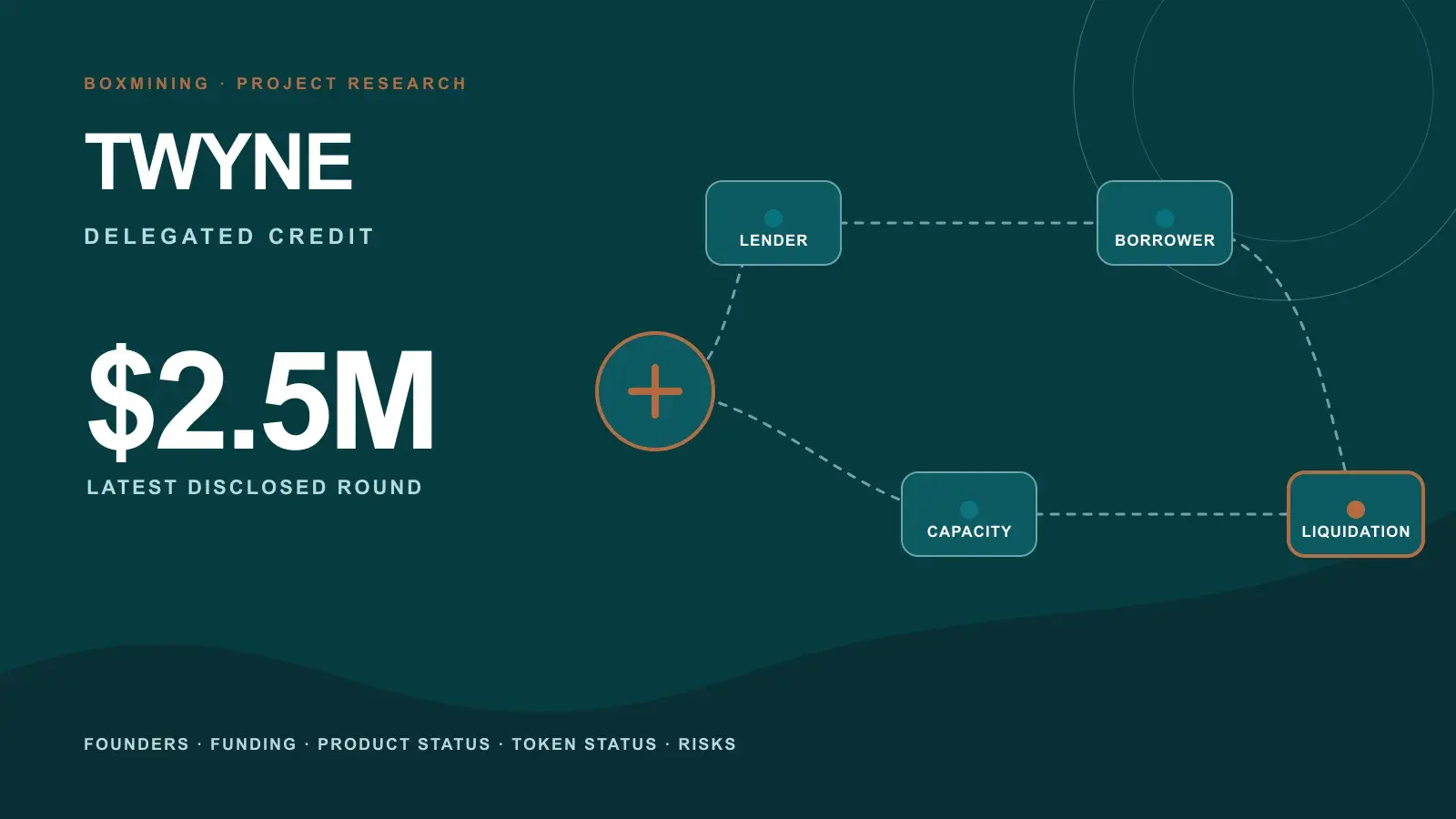
Research update — August 19, 2026: The $2.5 million seed was reported after this article’s July filing date. We updated the profile while preserving the requested archive date. Twyne had not published a first-party closing announcement at our cutoff.
Twyne is trying to make idle borrowing capacity productive. Instead of a lender simply depositing collateral and leaving the unused credit line untouched, the protocol lets that capacity be delegated to another borrower for a fee.
The mechanism is inventive and live. The newest funding evidence is less complete. Cyber Fund and Ethereal Ventures are reported to have led a $2.5 million seed, but Twyne’s own site still said “Announcing Seed Soon” when we checked.
Why the reported seed matters
The round appears in Cyber Fund’s portfolio, HackQuest’s project profile and DefiLlama funding data. Euler and Daedalus reportedly participated. Added to a reported $450,000 pre-seed, Twyne’s cumulative financing is about $2.95 million.
That is enough corroboration to discuss the round, but not enough to label every term fully verified. We do not know whether the financing was equity, tokens, warrants or a mix. The graphical funding status above therefore says “announced,” not “closed.”
What Twyne does in plain English
DeFi borrowers often post more collateral than they use. Twyne lets a lender delegate unused borrowing power to another account. The lender earns a delegation fee; the borrower can obtain more leverage or a wider buffer before liquidation.
Twyne is built around Euler- and Aave-style lending infrastructure. Its contracts are public, and the project publishes security information.
The same feature that improves capital efficiency also increases system complexity. Delegated leverage creates another path through which oracle moves, liquidity shortages or liquidation failures can spread.
What is live today
At our August 19 cutoff, DefiLlama showed about $14.53 million in TVL and $12.67 million borrowed. That close relationship indicates high utilization. It does not mean Twyne earned $12.67 million or that all positions are equally liquid.
The code, audit disclosures and live usage make Twyne more than a pitch deck. The small scale and young contracts still place it firmly in the experimental DeFi category.
Who is building Twyne
Twyne’s core team is substantially pseudonymous. A detailed Lido Alliance proposal identifies contributors including Engn33r and Bunbun on smart-contract and security work, Taulant on business operations, Daniele on risk and investment, and Jakub on data science.
We did not find verified official real-name founder portraits. That is why the funding panel uses official project artwork and clearly labels the limitation. We will not borrow a similarly named LinkedIn photograph and turn an inference into identity.
Pseudonymity is not automatic evidence of misconduct, but it reduces legal and reputational accountability if something goes wrong.
Who funded Twyne
Cyber Fund and Ethereal Ventures are the reported seed leads. Euler Labs is strategically important because Twyne depends on lending infrastructure in the Euler ecosystem. Daedalus appears in both early financing reports.
The investor mix fits a specialist mechanism-design project. It does not remove the need to verify final documents, token rights or team identity.
Token status
Twyne has not disclosed an official native token, TGE, allocation or verified contract. Delegation fees accrue to participating lenders under the protocol design; they do not automatically accrue to a future token. Any TWYNE asset marketed elsewhere should be treated as unaffiliated until the project confirms it.
Main risks
- Leverage risk: delegated credit can amplify liquidation and bad debt.
- Dependency risk: Twyne relies on lending modules, oracles and external liquidity.
- Young-contract risk: audits and bounties reduce, but never eliminate, exploit risk.
- Concentration risk: early positions can dominate a small protocol.
- Team accountability: core contributors remain pseudonymous.
- Funding verification: the newest round lacked a first-party closing release at cutoff.
Bottom line
Twyne is a legitimate experimental protocol with public code, live funds and a novel credit-delegation mechanism. It belongs on a DeFi watchlist. It does not yet deserve the same evidence rating as a company with named legal founders and a primary funding announcement.
The hot idea is delegated credit. The investable conclusion is still pending: no token is confirmed, the capital instrument is undisclosed and the protocol’s leverage path needs close monitoring.
Twyne funding FAQ
Did Twyne raise $2.5 million?
The seed is reported by investor and industry databases, but Twyne had not published a first-party closing announcement at our August 19 cutoff.
Does Twyne have a token?
No official token, TGE, tokenomics or verified contract was disclosed in the project material reviewed.
Are Twyne’s founders public?
The core team is substantially pseudonymous. Public proposals identify contributor handles and backgrounds, but not a fully verified legal founder roster with official portraits.
Sources and verification
Primary or near-primary references include the Twyne site, security page, open-source contracts, Lido Alliance team proposal and Cyber Fund portfolio. Live metrics are a dated DefiLlama snapshot.
Share
Found this useful?
Share it with someone who'd want to read it.
Related
Morpho: Inside the $175M Bet on Open Credit
Morpho’s $175 million round unites crypto-native VCs and major institutions around open credit. Here is what the money, token and risks actually mean.
Midas: The $50M Push to Make RWAs Liquid
Midas has raised $50 million to build a faster liquidity layer for tokenized financial products. We separate the RWA story from issuer, custody and token risks.
Digital Asset: The $355M Institutional Bet on Canton
Digital Asset’s $355 million round brings venture, banks, market makers and asset managers into one institutional blockchain bet. We separate equity, network activity and Canton Coin.