
Research update — August 19, 2026: This profile is filed to July so it does not displace current breaking news. Product and TVL figures were refreshed on the modified date.
Midas is building onchain products that look less like a speculative token and more like programmable fund shares. Its mTokens package exposures such as government securities, private credit and other managed strategies into transferable blockchain instruments.
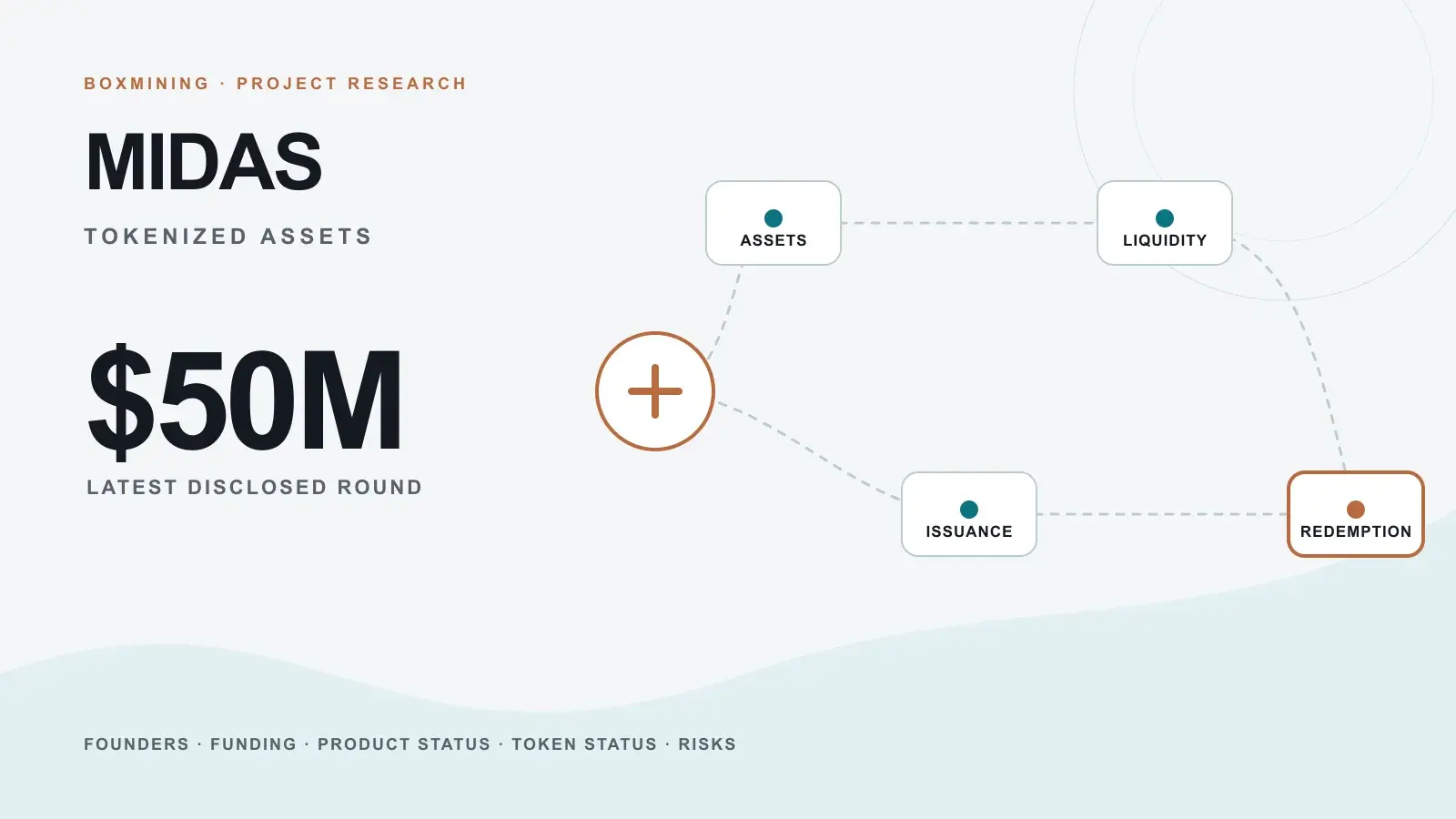
The company’s $50 million Series A shows why real-world assets remain hot with venture investors: the opportunity is not only tokenizing an asset, but making issuance, redemption, settlement and secondary liquidity work inside DeFi.
Why the Series A matters
Midas announced the $50 million Series A on March 30, 2026. RRE Ventures and Creandum co-led. Framework Ventures, HV Capital, North Island, FJ Labs, Coinbase Ventures, Franklin Templeton, GSR, Ledger Cathay, Anchorage and others participated.
The round followed a $8.75 million seed co-led by Framework, BlockTower and HV Capital. Midas’ March recap reports $58.75 million in total funding.
The financing thesis is “instant liquidity” for tokenized investment products. That is a harder problem than minting a token. It requires legal wrappers, reliable valuation, custody, distribution, compliance and redemption paths that still work under market stress.
What Midas does in plain English
Midas Software GmbH creates mTokens, each tied to a defined product structure. The official product explainer describes blockchain-based investment products that can plug into wallets and DeFi while maintaining their own eligibility and legal terms.
An mToken is not a generic stablecoin and not a share in Midas. It represents exposure to one named product. Investors therefore need to examine the issuer, manager, custodian, valuation process, permitted jurisdictions and redemption terms for that specific token.
What is live today
Midas said in its August mWIN announcement that it had passed $2 billion in cumulative asset issuance and paid $46 million in yield. The same product announcement names Wellington Management and Northern Trust in the structure.
At our cutoff, DefiLlama showed about $128.8 million in current TVL. Cumulative issuance and live TVL measure different things: issuance counts historical product flow, while TVL is a point-in-time estimate of value currently tracked.
Who founded Midas
Midas’ official team page names three co-founders:
- Dennis Dinkelmeyer, CEO, with prior investment experience at Goldman Sachs and Capital Group.
- Fabrice Grinda, executive chair, founding partner of FJ Labs and a long-time technology investor.
- Romain Bourgois, chief product officer, previously head of product at Ondo, where he worked on OUSG, Flux and USDY.
That team composition matches the product challenge: traditional investment experience, venture distribution and hands-on tokenized-asset product work.
Who funded Midas—and why the mix matters
RRE Ventures and Creandum are generalist venture firms with fintech exposure. Framework Ventures brings crypto-native DeFi experience. Coinbase Ventures adds distribution and onchain-market context. Franklin Templeton is an asset manager, not a conventional VC.
Together, they map the RWA stack: regulated product manufacturing on one side and crypto distribution, wallets and liquidity on the other.
Token status and retail access
Midas has not disclosed a native governance or equity token. Individual mTokens are product instruments; holding one does not grant ownership of Midas, voting power over the company or a general claim on all platform revenue.
This also means our existing Midas token airdrop guide should be treated as a separate campaign-tracking page, not proof that a corporate token is guaranteed.
Main risks
- Issuer and legal-wrapper risk: the claim depends on the product documents and entity structure.
- Manager and custodian risk: offchain assets introduce counterparties.
- Redemption risk: instant liquidity can weaken during stress or outside operating windows.
- Eligibility risk: products may exclude users by jurisdiction or investor status.
- Smart-contract risk: composability adds contract and integration exposure.
- Valuation risk: private credit and less liquid assets may not have continuous, transparent prices.
Midas publishes prospectus and legal documents, but users must read the documents for the exact product they want—not assume one disclosure covers every mToken.
Bottom line
Midas is a credible RWA infrastructure company with named institutional partners, live products and substantial financing. Its round shows that VCs are funding the plumbing around tokenized assets: liquidity, distribution and compliance.
The investor takeaway is practical. Evaluate each mToken as a financial product with its own issuer and collateral path. Do not substitute “funded by top VCs” for checking the terms.
Midas funding FAQ
How much has Midas raised?
Midas reports $58.75 million in total funding, including a $50 million Series A announced in March 2026.
Does Midas have a native token?
No native Midas governance or equity token was disclosed in the official material reviewed. mTokens are separate product-specific instruments.
Are Midas mTokens stablecoins?
Not generally. Each mToken represents a defined onchain investment product with its own NAV, eligibility, issuer and risk structure.
Sources and verification
Primary references include the Midas team page, official documentation, Series A announcement, funding recap, mWIN announcement and legal-document library.
Share
Found this useful?
Share it with someone who'd want to read it.
Related
Digital Asset: The $355M Institutional Bet on Canton
Digital Asset’s $355 million round brings venture, banks, market makers and asset managers into one institutional blockchain bet. We separate equity, network activity and Canton Coin.
Squads and Altitude: The $18M Stablecoin Finance Bet
Squads’ new funding is a bet that stablecoins become business banking infrastructure. We examine Altitude, the founders, investor network, live claims and dependencies.
Velocity: The $38M Stablecoin Treasury Bet
Velocity’s $38 million Series A shows stablecoins moving into enterprise treasury software. We examine the founder transition, product evidence, investor mix and hidden dependencies.