
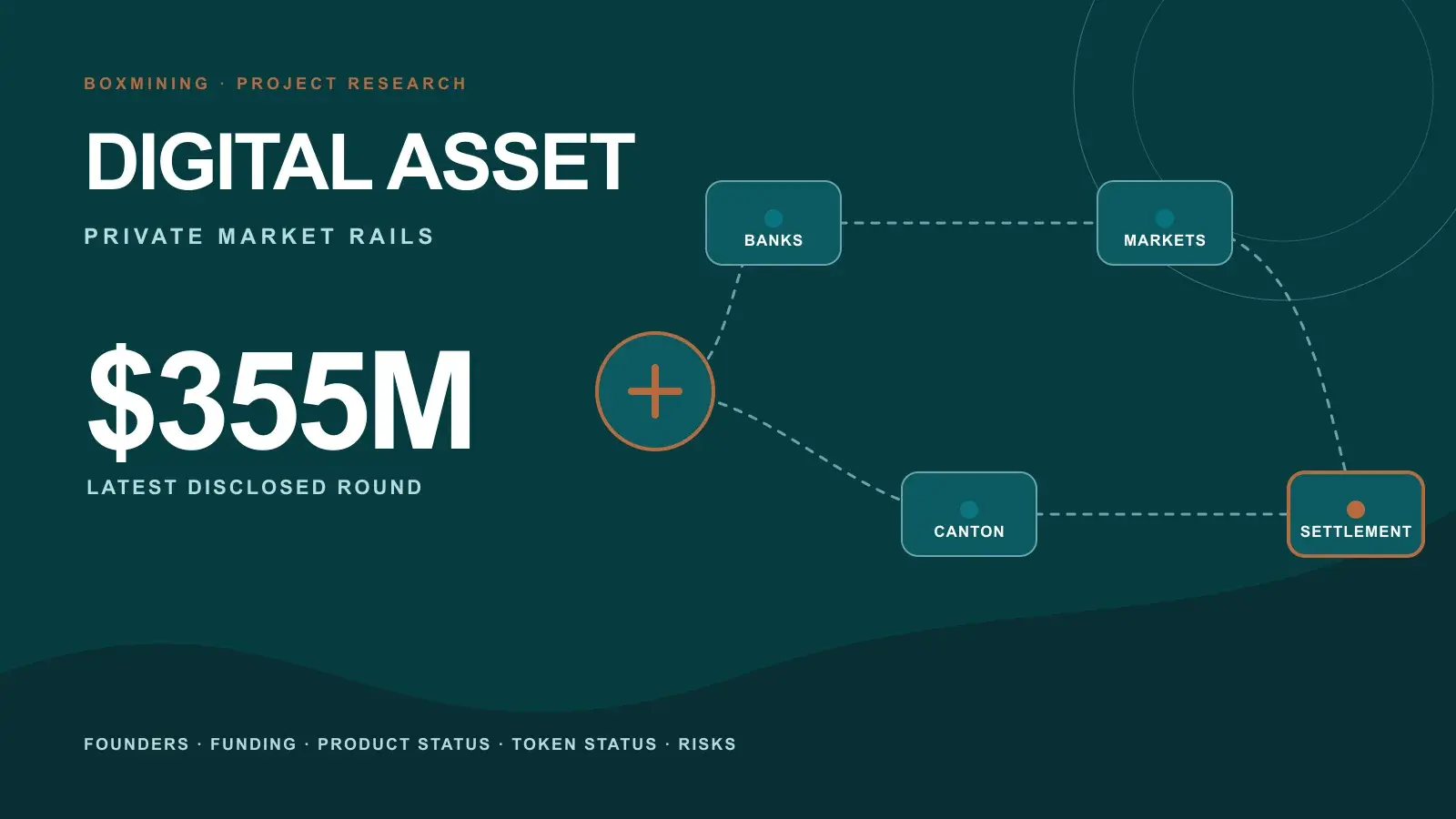
Research update — August 19, 2026: This article is filed to July so it does not displace current breaking news. It includes the July expansion of the financing and August diligence.
Digital Asset’s $355 million financing is one of the strongest signals that the real-world asset narrative has moved from proofs of concept toward institutional market infrastructure. The company created Canton Network, a public blockchain designed to let regulated firms coordinate assets and workflows while keeping sensitive data private.
The investor roster is unusually revealing: a16z crypto led, while banks, exchanges, asset managers, market makers and financial-market utilities participated. This is not a simple bet on a retail Layer 1.
Why the $355 million round matters
Digital Asset announced the round on June 11, 2026. Participants included Apollo Funds, Coinbase Ventures, Polychain, ABN Amro, BNP Paribas, Broadridge, Citadel Securities, CME Ventures, HSBC, iCapital, Optiver, S&P Global, SBI, SoFi and Tradeweb. A July expansion added Shinhan Financial Group and SC Ventures without disclosing a revised total.
Digital Asset previously disclosed a $120 million Series D in 2021 and a $135 million Series E in 2025. Those recent named rounds total at least $610 million, although the company’s complete lifetime funding history may include other transactions.
What Digital Asset and Canton do
Digital Asset is the software company. Canton is the network. The Canton Foundation is an independent ecosystem organization. Canton Coin is the network utility asset. Keeping those four labels separate prevents most analytical mistakes.
Canton’s design lets applications synchronize transactions while controlling who can see each piece of data. That is attractive for regulated assets, where counterparties need shared settlement but cannot publish every position, client identity or contract term to a fully transparent chain.
The tradeoff is obvious: privacy and institutional control make independent public verification harder than on a transparent DeFi protocol.
What is live today
Digital Asset reported more than 700 ecosystem participants in June. Its DA Registry announcement says more than 35 tokenization providers and issuers can connect assets into workflows spanning over 1.5 million daily Canton transactions.
Canton separately cites more than 150 live or emerging applications and over 50 super validators. These are network and company claims, not audited revenue. Likewise, “assets processed daily” should not be read as locked collateral or assets owned by Digital Asset.
Who founded Digital Asset
The official team page identifies three co-founders:
- Yuval Rooz, CEO, previously at Citadel and DRW, where he worked in algorithmic trading and venture activity.
- Eric Saraniecki, head of network strategy, a former DRW commodities trader and co-founder of Cumberland.
- Shaul Kfir, head of strategic initiatives, a cryptography engineer and libsnark co-author.
That mix explains Canton’s positioning: market structure and cryptography first, retail token promotion second.
Who funded Digital Asset
a16z crypto is the venture lead. Apollo brings large-scale credit and asset-management context. Coinbase Ventures adds crypto distribution. The rest of the round spans banks, trading firms, exchanges and market utilities.
This is important for readers mapping the VC scene. Institutional RWA funding is increasingly syndicated across operators that may eventually use the rails—not only funds hoping for token appreciation.
Canton Coin is not Digital Asset equity
Canton Coin pays Global Synchronizer traffic fees and rewards network contributors. Canton says there was no premine, presale or VC allocation. Usage fees are burned while contribution rewards are minted.
Digital Asset’s equity financing therefore does not imply that investors bought a discounted pool of Canton Coin. CC also does not represent shares or a claim on Digital Asset’s corporate revenue. Token demand depends on actual synchronizer usage, while issuance depends on rewards and network policy.
Main risks
- Verification risk: privacy makes public state and activity harder to audit independently.
- Governance concentration: super-validator influence is institution-heavy.
- Integration complexity: regulated assets require legal, operational and technical coordination.
- Token economics: CC issuance can exceed burn, and synchronizer use is optional.
- Entity confusion: company equity, foundation participation and CC are separate exposures.
Bottom line
Digital Asset is a legitimate, deeply funded institutional blockchain company with credible founders and an unusually strong strategic investor group. Canton is hot because it attacks the difficult part of RWA adoption: coordinating regulated assets and firms without making every transaction public.
For retail investors, the clean conclusion is not “banks invested, therefore buy CC.” It is that institutional tokenization infrastructure is attracting serious capital—and Canton Coin still needs a separate usage, supply and valuation analysis.
Canton funding FAQ
How much did Digital Asset raise in 2026?
Digital Asset announced $355 million in June 2026 and later added Shinhan Financial Group and SC Ventures without publishing a revised total.
Is Canton Coin a VC token?
Canton says CC had no premine, presale or VC allocation. It is a network utility and reward asset, not Digital Asset equity.
Is Canton a private blockchain?
Canton describes itself as a public institutional network with configurable privacy. Applications can coordinate shared transactions without exposing all private data to everyone.
Sources and verification
Primary references include the Digital Asset team page, $355 million announcement, round expansion, DA Registry update, Canton Coin documentation and Canton FAQ.
Share
Found this useful?
Share it with someone who'd want to read it.
Related
Midas: The $50M Push to Make RWAs Liquid
Midas has raised $50 million to build a faster liquidity layer for tokenized financial products. We separate the RWA story from issuer, custody and token risks.
Morpho: Inside the $175M Bet on Open Credit
Morpho’s $175 million round unites crypto-native VCs and major institutions around open credit. Here is what the money, token and risks actually mean.
Squads and Altitude: The $18M Stablecoin Finance Bet
Squads’ new funding is a bet that stablecoins become business banking infrastructure. We examine Altitude, the founders, investor network, live claims and dependencies.