
Research update — August 19, 2026: This profile is filed to July so it does not displace current breaking news. Live metrics and diligence were refreshed on the modified date shown above.
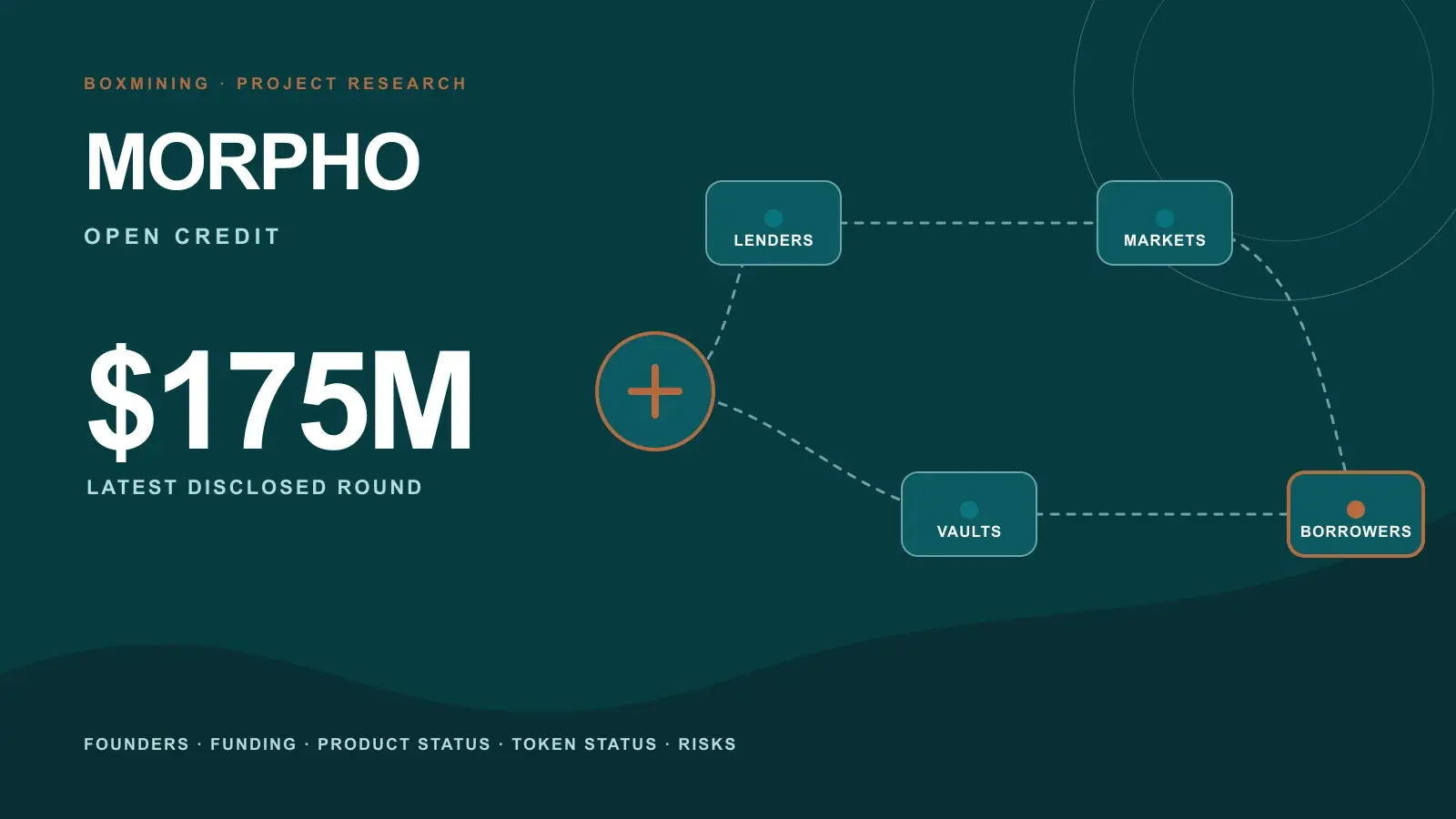
Morpho is one of the clearest examples of venture capital moving beyond “another DeFi app” and into open financial infrastructure. The network lets developers and risk managers assemble lending markets and vaults around a shared, permissionless credit layer. Its new $175 million financing puts three repeat crypto backers—Paradigm, a16z crypto and Ribbit Capital—beside institutions including Apollo Funds, Circle Ventures and VanEck.
That is a strong capital signal. It is not, by itself, a reason to buy the MORPHO token.
Why the $175 million round matters
The June 2026 announcement says the Morpho Association raised $175 million to expand the open credit network. Paradigm, a16z crypto and Ribbit co-led; Apollo Funds, Circle Ventures, VanEck, Ledger Cathay, Variant, Wintermute Ventures, IOSG, HashKey and others participated.
Morpho has now attracted several kinds of capital at different stages. It reported a $1.35 million seed in 2021, an $18 million native-token sale in 2022, a $50 million Ribbit-led round in 2024 and the new association financing. Adding them produces roughly $244 million, but that headline combines company, token and association transactions. Investors should not treat those instruments as interchangeable.
What Morpho does in plain English
Traditional DeFi lending protocols make many risk choices centrally: which collateral is accepted, which oracle is used and how a pool is configured. Morpho separates the base lending primitive from the people and businesses that package risk for users.
Permissionless markets can be created around specific collateral, loan assets, oracles and liquidation parameters. Vault curators can then allocate deposits across markets according to a stated strategy. The result is closer to an open credit operating system than a single pool.
That modularity creates flexibility, but it also moves diligence onto users. A familiar interface does not make every market equally safe.
What is live today
Morpho’s funding release reported more than $11 billion in deposits and integrations or usage involving Bitwise, Galaxy, Anchorage, Coinbase, Kraken, Binance, Ledger, Trezor and Bitpanda. At our August 19 cutoff, DefiLlama’s Morpho Blue dashboard showed about $12.66 billion in TVL and $4.49 billion borrowed.
Those figures are useful measures of protocol activity, not revenue, insured deposits or a guarantee that every vault can redeem without loss.
Who founded Morpho
Morpho’s technical work is associated with Paul Frambot, Merlin Egalité, Mathis Gontier Delaunay and Julien Thomas. The Morpho yellow paper lists all four as Morpho Labs authors; company materials identify Paul as co-founder and CEO and Merlin as co-founder and head of integration.
The structure matters. Morpho’s organization documentation distinguishes the French nonprofit Morpho Association, the Morpho Labs development company and token-governed network processes. A financing announcement for one entity should not be read as a direct claim on the others.
Who funded Morpho—and what that tells us
Paradigm, a16z crypto and Ribbit Capital are the key lead signals. Paradigm and a16z bring crypto protocol research and network experience; Ribbit brings fintech and credit-market context. Apollo is strategically different: it is a large alternative asset manager, not a crypto venture fund.
That mix suggests a thesis bigger than yield farming. The bet is that open, programmable credit can become useful distribution infrastructure for wallets, exchanges, fintechs and asset managers.
MORPHO token: live, but not equity
The MORPHO token became transferable in November 2024 and has a maximum supply of one billion. Governance can activate protocol fees capped at 25% of borrower interest, but that choice is discretionary. The token does not represent shares in Morpho Labs or an automatic dividend from the association’s financing.
Retail investors therefore need a separate token analysis: circulating supply, unlocks, governance concentration, liquidity, fee decisions and valuation. A famous VC roster does not settle those questions.
Main risks
- Permissionless-market risk: collateral, oracle and liquidation choices can fail.
- Curator risk: vault allocators can make poor or concentrated decisions.
- Bad debt and liquidity: liquidations may not clear cleanly during stress.
- Integration risk: a wallet or fintech front end adds another operational layer.
- Governance concentration: token ownership and delegation can shape fee and risk policy.
Morpho itself added risk warnings as it moved toward a more permissionless interface. That is healthy disclosure, not proof that the risk has disappeared.
Bottom line
Morpho is a legitimate, live DeFi credit network with material usage, public technical documentation and unusually deep financing. The hot narrative is not simply “DeFi lending is back.” It is that crypto credit is being packaged as reusable infrastructure for institutions and consumer distribution.
The investment conclusion is narrower: the network merits attention, while MORPHO still requires its own supply, governance and valuation work.
Morpho funding FAQ
How much did Morpho raise in 2026?
The Morpho Association announced $175 million on June 9, 2026, co-led by Paradigm, a16z crypto and Ribbit Capital.
Does Morpho funding give investors MORPHO tokens?
The announcement does not make company or association financing equivalent to buying the token. MORPHO is a separate governance asset with its own market and supply risks.
Is Morpho live?
Yes. It has live lending markets and vaults, public code and multi-billion-dollar activity, although every market and curator still needs individual diligence.
Sources and verification
Primary references include Morpho’s organization overview, token documentation, yellow paper, $175 million announcement and permissionless-market risk notice. Live TVL is a dated third-party snapshot, not a permanent fact.
Share
Found this useful?
Share it with someone who'd want to read it.
Related
Twyne: The Reported $2.5M Bet on Delegated Credit
Twyne turns unused borrowing power into a market. Its early usage is real, but its newest funding and pseudonymous team require more caution than a normal venture profile.
Midas: The $50M Push to Make RWAs Liquid
Midas has raised $50 million to build a faster liquidity layer for tokenized financial products. We separate the RWA story from issuer, custody and token risks.
Digital Asset: The $355M Institutional Bet on Canton
Digital Asset’s $355 million round brings venture, banks, market makers and asset managers into one institutional blockchain bet. We separate equity, network activity and Canton Coin.