
Research update — August 19, 2026: This profile is filed to July so it does not displace current breaking news. Company, funding and leadership evidence were checked on the modified date.
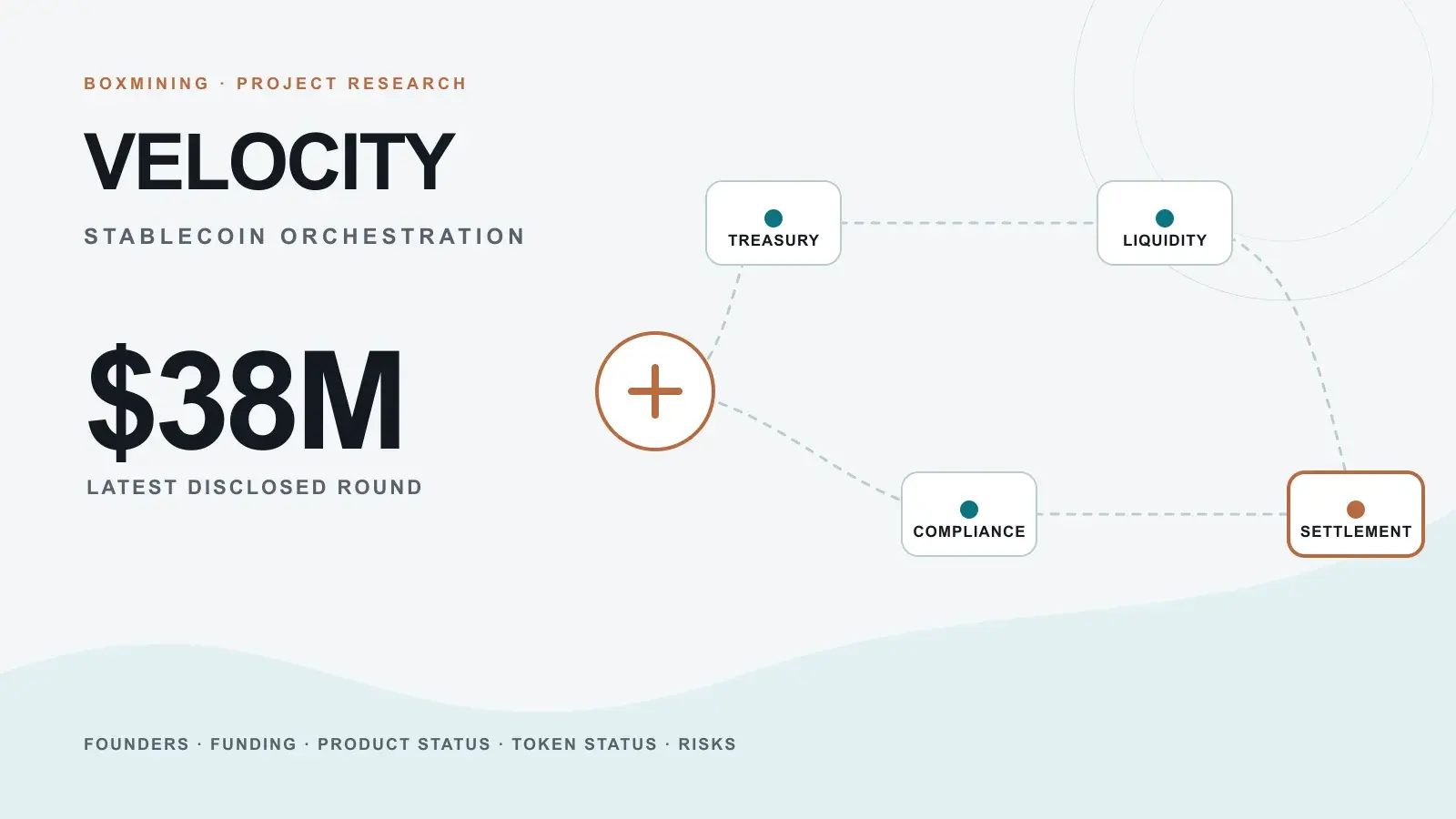
Velocity is building the control layer between stablecoins and the systems a finance team already uses. Its pitch combines payments, treasury, foreign exchange, custody, compliance and settlement rather than asking a company to stitch those services together itself.
The $38 million Series A is a useful snapshot of the current market. A crypto-native lead, a mainstream software VC, fintech specialists, a bank venture arm, a stablecoin operator and a market maker all joined the same round.
Why the Series A matters
Velocity announced $38 million on July 14, 2026. Dragonfly and FirstMark co-led. Activant Capital, Capital One Ventures, QED Investors, Coinbase Ventures, Wintermute Ventures and Ripple participated.
The company previously raised a $10 million pre-seed led by Activant in May 2025. That makes $48 million of disclosed financing; Velocity rounds this to “nearly $50 million.” No valuation was announced.
What Velocity does
Velocity gives businesses one integration surface for stablecoin and fiat money movement. A treasury team can route payments, access liquidity, manage custody choices and reconcile settlement without treating each chain or provider as a separate product.
This is not a decentralized protocol in the usual DeFi sense. It is enterprise financial software using blockchain and regulated stablecoins as settlement tools. The company exposes a developer integration surface and has announced an identity and compliance partnership with Prove.
Its Trust Center lists SOC 2 Type I and ISO 27001. SOC 2 Type II was still shown as in progress at our cutoff. Those controls matter, but they do not certify every bank, custodian, liquidity venue or stablecoin connected to the platform.
What is live—and what remains undisclosed
Velocity says it works with global merchants, payment providers, fintechs and financial institutions. It has not named a representative customer list or published audited payment volume, revenue or stablecoin balances.
That is the biggest diligence gap. The product surface and compliance work suggest real execution, but investors cannot independently measure adoption from the available data.
Who founded Velocity
Eric Queathem is the current founder and CEO shown on Velocity’s leadership page. He spent nearly a decade at Worldpay leading global strategy and growth across traditional and crypto markets, after earlier work at McKinsey.
Tom Greenwood co-founded Velocity and was its original CEO. He previously founded Volt and IFX, but is no longer on the current leadership page; UK filings show his directorship ended in late 2025. We therefore treat him as a historical co-founder, not current management.
Who funded Velocity
Dragonfly brings crypto protocol and market experience. FirstMark is a mainstream early-stage technology investor. Activant Capital specializes in commerce infrastructure, while QED Investors is a fintech specialist. Coinbase Ventures, Ripple and Wintermute Ventures add distribution, settlement and liquidity context.
The message is clearer than any one logo: stablecoin treasury is being funded as serious fintech infrastructure.
Token status
Velocity has not announced a native token, TGE or contract. It uses third-party regulated stablecoins. Equity financing does not create a claim on a future token, and the absence of a token is consistent with enterprise treasury software.
Main risks
- Adoption opacity: customer names, revenue and processing volumes remain undisclosed.
- Provider dependency: banks, issuers, custodians and liquidity venues remain separate failure points.
- Regulatory fragmentation: licenses and stablecoin rules differ by jurisdiction.
- Yield risk: Velocity says third-party providers supply yield and that it does not guarantee or underwrite returns.
- Founder transition: the original CEO’s departure deserves monitoring even though current leadership is identified.
Bottom line
Velocity is a legitimate, well-funded enterprise stablecoin company with a product and compliance surface that extend beyond a concept deck. The hot theme is orchestration: businesses want stablecoin settlement without becoming blockchain operations teams.
The missing piece is public traction. Until named customers or audited volumes appear, treat the $38 million round as a strong institutional signal—not proof of product-market fit.
Velocity funding FAQ
How much has Velocity raised?
Velocity has disclosed $48 million: a $10 million pre-seed and a $38 million Series A.
Does Velocity have a crypto token?
No Velocity-issued token, TGE or official contract was found in the company materials reviewed.
Who is Velocity’s current CEO?
Eric Queathem is the current founder and CEO. Tom Greenwood was the original co-founder and CEO but is no longer shown as current management.
Sources and verification
Primary references include the Series A release, 2025 pre-seed release, platform site, leadership page, Trust Center and UK filing history.
Share
Found this useful?
Share it with someone who'd want to read it.
Related
Midas: The $50M Push to Make RWAs Liquid
Midas has raised $50 million to build a faster liquidity layer for tokenized financial products. We separate the RWA story from issuer, custody and token risks.
Squads and Altitude: The $18M Stablecoin Finance Bet
Squads’ new funding is a bet that stablecoins become business banking infrastructure. We examine Altitude, the founders, investor network, live claims and dependencies.
Cycles: The $6.4M Bet on Private Clearing
Cycles wants companies to settle only the residual after obligations cancel out. The seed is credible; the hard part is building a multi-party network that works under stress.