
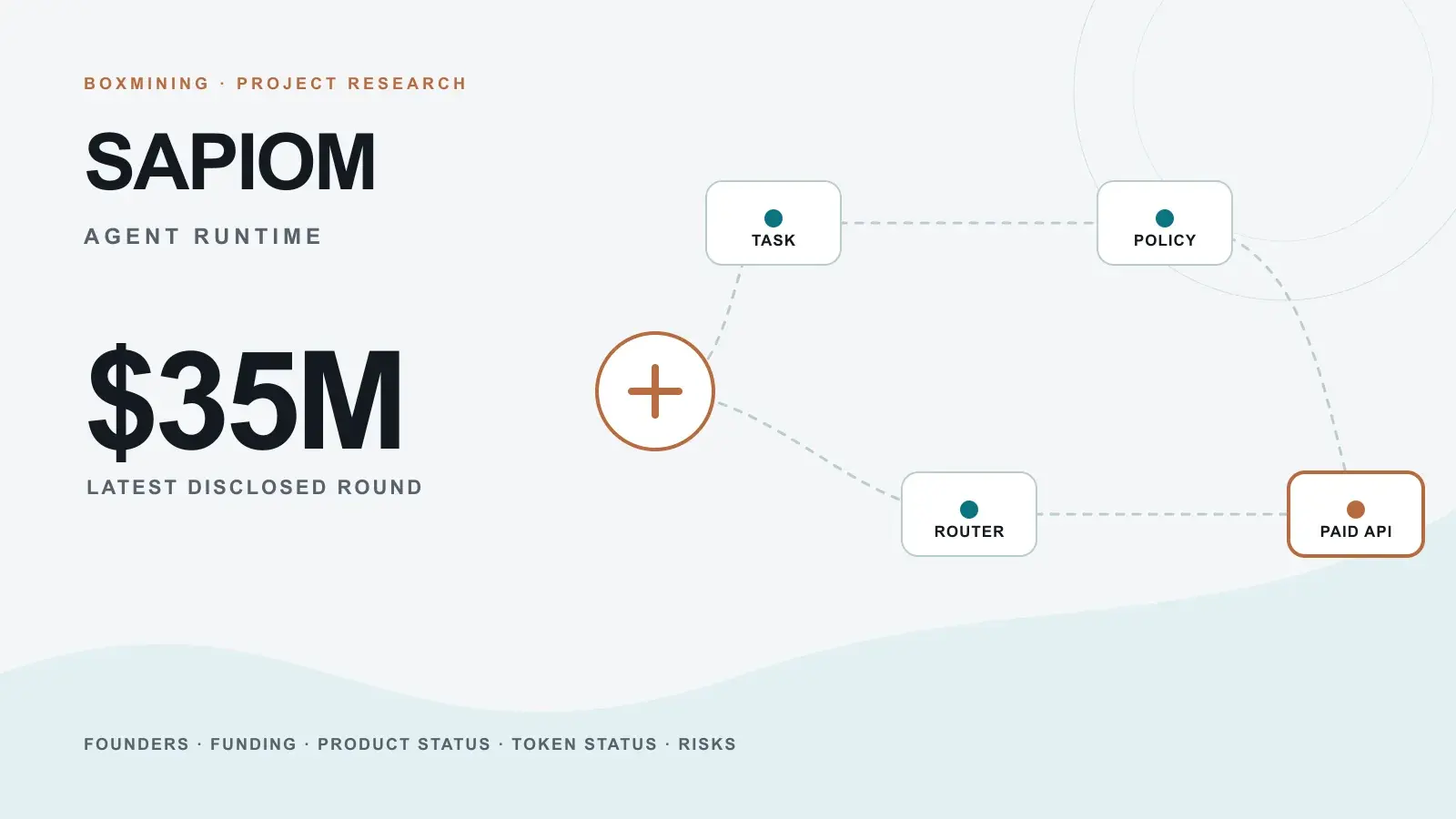
Research update — August 19, 2026: Sapiom announced its Series A after this article’s July filing date. We updated the profile while preserving the requested archive date.
Sapiom started with a sharp problem: an AI agent cannot reliably buy API access if it lacks identity, policy controls and a programmable way to pay. By August 2026, the company had expanded into a broader runtime platform for routing models, governing agent execution and recording what happened.
That makes Sapiom one of the strongest examples of crypto ideas being absorbed into mainstream AI infrastructure. Wallets and payment orchestration remain part of the product, but the company is not a DeFi protocol.
Why the $35 million Series A matters
Sapiom announced the round on August 5, 2026. Dragonfly led. Accel, Gradient Ventures, Coinbase Ventures, Operator Collective, Formus Capital and VanEck Ventures participated, with continued support from Okta Ventures, Menlo Ventures, Anthropic and Array Ventures.
The company previously announced a $15.75 million seed led by Accel. Adding the disclosed figures gives $50.75 million, while the Series A release rounds total funding to $50 million.
Dragonfly partner Haseeb Qureshi joined the board, showing that the crypto-native lead is treating agent infrastructure as a durable company thesis rather than a token-only trade.
What Sapiom does
Sapiom’s current product includes:
- Router, which chooses models and providers based on cost, capability and policy.
- Agent Studio, which helps build and inspect agents.
- Runtime, which deploys agents, schedules work and records execution.
- Payments and wallets, which let agents access paid services within defined controls.
The documentation shows local testing, deployment, schedules, cloud operation and capability calls. That is more concrete than a narrative landing page.
What is live today
Sapiom says it processed more than 270 million transactions and 100,000 agent runs per day in its first six months. It also cites a customer reducing inference costs by 75%.
Those are company claims and have not been independently audited. “Transaction” can also mean an internal platform event rather than a blockchain payment, so the figure should not be presented as onchain volume.
Who founded Sapiom
Ilan Zerbib, founder and CEO, previously served as a Shopify director of engineering for payments. He says his team helped scale Shop Pay beyond $100 billion in gross merchandise value and built Shop Cash. Earlier, he co-founded Earny, which was acquired in 2021.
That background explains the product’s emphasis on payments and operational reliability rather than speculative token mechanics.
Who funded Sapiom
Dragonfly leads the crypto side. Accel and Gradient Ventures validate the broader software and AI case. Coinbase Ventures and VanEck Ventures connect the company to digital-asset infrastructure. Anthropic is a strategic model-company participant, not a general-purpose VC fund.
The round shows what is hot: investors are funding agent governance, routing and payments as one infrastructure layer.
Token status
Sapiom has not announced a token, TGE or contract. Its service credits are prepaid and dollar-denominated; they should not be described as cryptoassets. Equity financing gives no retail claim on a future token.
Main risks
- Metric verification: usage and savings figures are company supplied.
- Focus risk: Sapiom moved quickly from payments into a broad runtime platform.
- Competition: model gateways, clouds and open-source routers overlap with its product.
- Provider dependency: third-party models and APIs affect cost, margin and uptime.
- Compliance responsibility: Sapiom’s terms place AML, sanctions, export and consumer-law obligations on agents and customers.
Bottom line
Sapiom is a legitimate, strongly funded AI infrastructure company with payments roots and crypto-native backers. It belongs in the crypto-and-AI watchlist because agents need programmable economic access. It should not be mislabeled as a DeFi protocol.
The hot opportunity is the control plane for autonomous software. The risk is that Sapiom is competing in a crowded AI stack while its most impressive metrics remain unaudited.
Sapiom funding FAQ
How much has Sapiom raised?
Sapiom reports about $50 million across a seed and $35 million Series A, although the exact disclosed figures sum to $50.75 million.
Is Sapiom a crypto project?
It is AI infrastructure with programmable-wallet and payment roots plus crypto-native investors. It is not a DeFi protocol.
Does Sapiom have a token?
No official token, TGE or contract was found. Its service credits are dollar-denominated prepaid credits.
Sources and verification
Primary references include Sapiom’s seed announcement, Series A story, current documentation, terms of use and API reference.
Share
Found this useful?
Share it with someone who'd want to read it.
Related
Kite AI: The $18M Bet on Agentic Payments
Kite combines an AI-agent identity layer, app discovery and stablecoin settlement. Its mainnet and token are live, but agent commerce is still an experimental market.
Velocity: The $38M Stablecoin Treasury Bet
Velocity’s $38 million Series A shows stablecoins moving into enterprise treasury software. We examine the founder transition, product evidence, investor mix and hidden dependencies.
Morpho: Inside the $175M Bet on Open Credit
Morpho’s $175 million round unites crypto-native VCs and major institutions around open credit. Here is what the money, token and risks actually mean.