
Research update — August 19, 2026: This profile is filed to July so it does not displace current breaking news. Mainnet and token information was refreshed on the modified date.
Kite is betting that AI agents will need more than wallets. An autonomous system spending money needs an identity, permissions, budgets, service discovery and a record of who authorized each action.
That is where crypto and AI narratives meet. Kite combines an EVM-compatible Layer 1 with Agent Passport and an application marketplace designed for machine-to-machine and agent-to-merchant transactions.
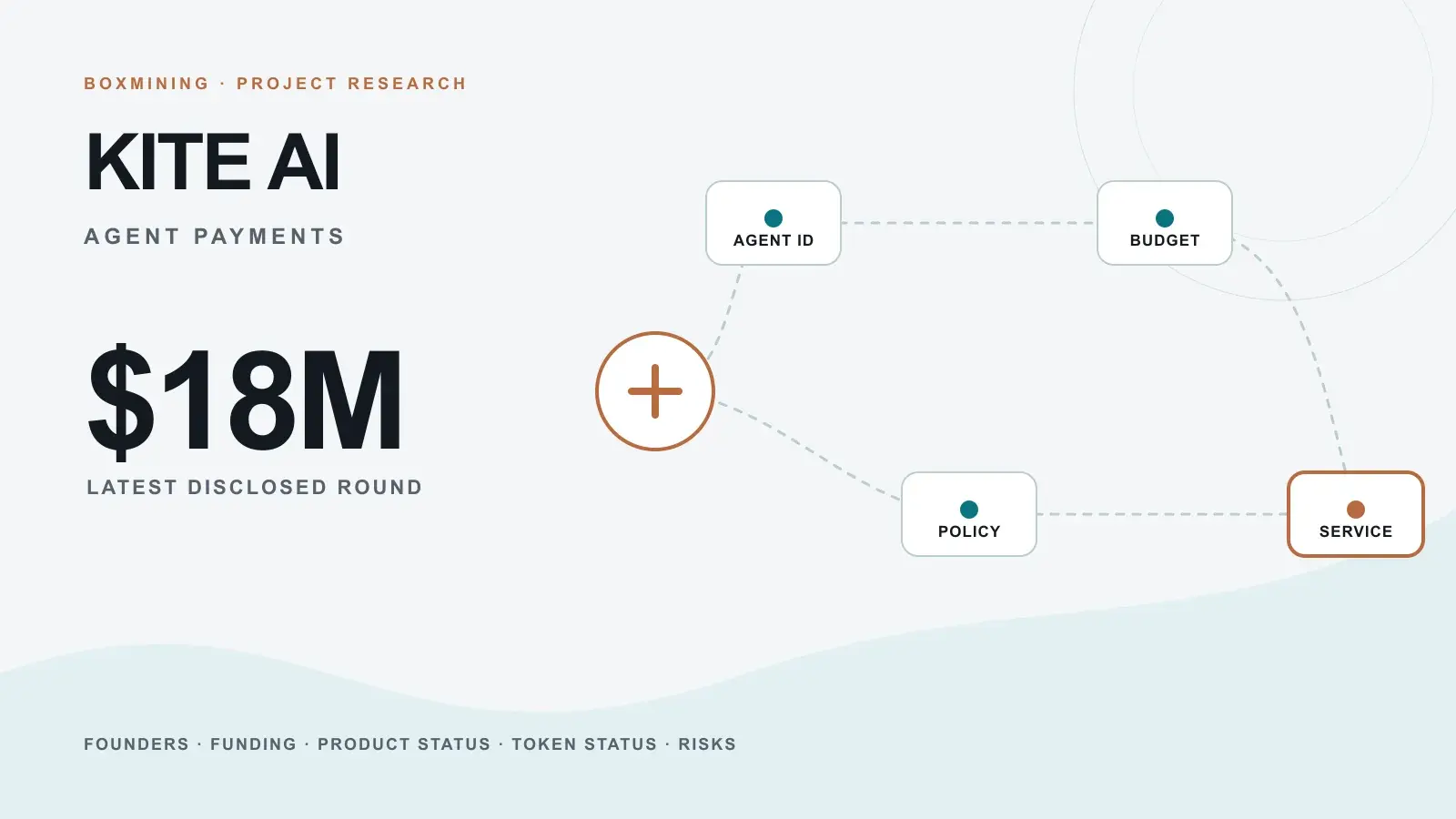
Why the $18 million Series A matters
Kite announced the Series A in September 2025. PayPal Ventures and General Catalyst co-led. 8VC, Samsung Next, SBI US Gateway, Vertex Ventures US, Hashed, HashKey, Animoca Brands, GSR Markets, LayerZero Labs, Alchemy and others participated.
The round brought disclosed funding to $33 million. Coinbase Ventures later announced a strategic Series A extension without stating the amount. Kite’s current company page says $35 million raised, suggesting additional capital, but that difference is an inference rather than a separately priced public round.
What Kite does in plain English
Kite’s Agent Passport gives software agents cryptographic identities and programmable permissions. A user or business can define what an agent may access, how much it may spend and which actions require additional approval.
Kite’s app layer then helps agents find services and settle with stablecoins. The Series A release said PayPal and Shopify merchants could opt into the Agent App Store. A later Coinbase Ventures announcement focused on x402, an HTTP payment standard for programmatic access.
Availability is not mass adoption. PayPal Ventures itself noted that agentic transaction volume was limited and the experience remained clunky at the time of investment.
What is live today
Kite’s mainnet documentation publishes chain ID 2366, RPC endpoints and an explorer. Its contract list identifies deployed network assets.
That moves Kite beyond a testnet narrative. The unanswered question is demand: how many agents are repeatedly paying for useful services, and how much of that activity would exist without token incentives?
Who founded Kite
Chi Zhang, co-founder and CEO, has a PhD in AI from UC Berkeley and previously led core data products at Databricks. Scott Shi, co-founder, built real-time AI infrastructure at Uber and was a founding engineer on Salesforce Einstein AI. General Catalyst’s investment profile describes both backgrounds.
Kite was formerly known as ZettaBlock, so older funding and technical records may use that name.
Who funded Kite
PayPal Ventures is the clearest payments signal. General Catalyst brings a broad AI and software thesis. Coinbase Ventures connects Kite to x402 and crypto distribution. 8VC and Animoca Brands widen the generalist and Web3 network.
This is what makes Kite hot: major investors see agent commerce as a new software and payments category, not merely another chain.
KITE token status
KITE is live as the network’s gas and native token. Official tokenomics cap supply at 10 billion and allocate 48% to ecosystem and community, 20% to modules, 20% to team/advisers/early contributors and 12% to investors.
The token requires separate diligence on circulating supply, unlock schedules, exchange liquidity and actual fee demand. A 12% investor pool plus a 20% team/contributor pool creates meaningful insider exposure even if the headline community allocation is larger.
Main risks
- Market risk: agent commerce is not yet a proven high-volume category.
- Security risk: an agent identity does not guarantee correct or non-malicious output.
- Token unlock risk: team and investor allocations can affect supply.
- Value-capture risk: future buy pressure depends on real service revenue and usage.
- Platform competition: wallets, clouds and payment networks can offer overlapping controls.
Bottom line
Kite is one of the more developed crypto-AI projects in this batch because it has credible founders, top investors, a live mainnet and published tokenomics. The thesis—identity and payments for autonomous agents—is genuinely differentiated.
The caution is equally clear: infrastructure can launch before demand. Investors should measure paid agent activity and token unlocks, not just count integrations.
Kite funding FAQ
How much has Kite raised?
Kite’s current company page says $35 million. The publicly priced Series A was $18 million, with a later Coinbase Ventures extension whose amount was not disclosed.
Is the KITE token live?
Yes. Official mainnet documentation lists KITE as the native asset and publishes a maximum supply of 10 billion.
Can AI agents buy from PayPal and Shopify merchants?
The funding announcement said merchants could opt into Kite’s Agent App Store. That capability should not be confused with broad merchant adoption or audited transaction volume.
Sources and verification
Primary references include the PayPal Series A release, General Catalyst thesis, PayPal Ventures analysis, Coinbase extension, tokenomics and mainnet details.
Share
Found this useful?
Share it with someone who'd want to read it.
Related
Sapiom: The $35M Bet on AI Agent Infrastructure
Sapiom has expanded from agent payments into runtime and inference routing. Its funding is real and its usage claims are large, but it is AI infrastructure—not a DeFi protocol or token.
Velocity: The $38M Stablecoin Treasury Bet
Velocity’s $38 million Series A shows stablecoins moving into enterprise treasury software. We examine the founder transition, product evidence, investor mix and hidden dependencies.
Morpho: Inside the $175M Bet on Open Credit
Morpho’s $175 million round unites crypto-native VCs and major institutions around open credit. Here is what the money, token and risks actually mean.