
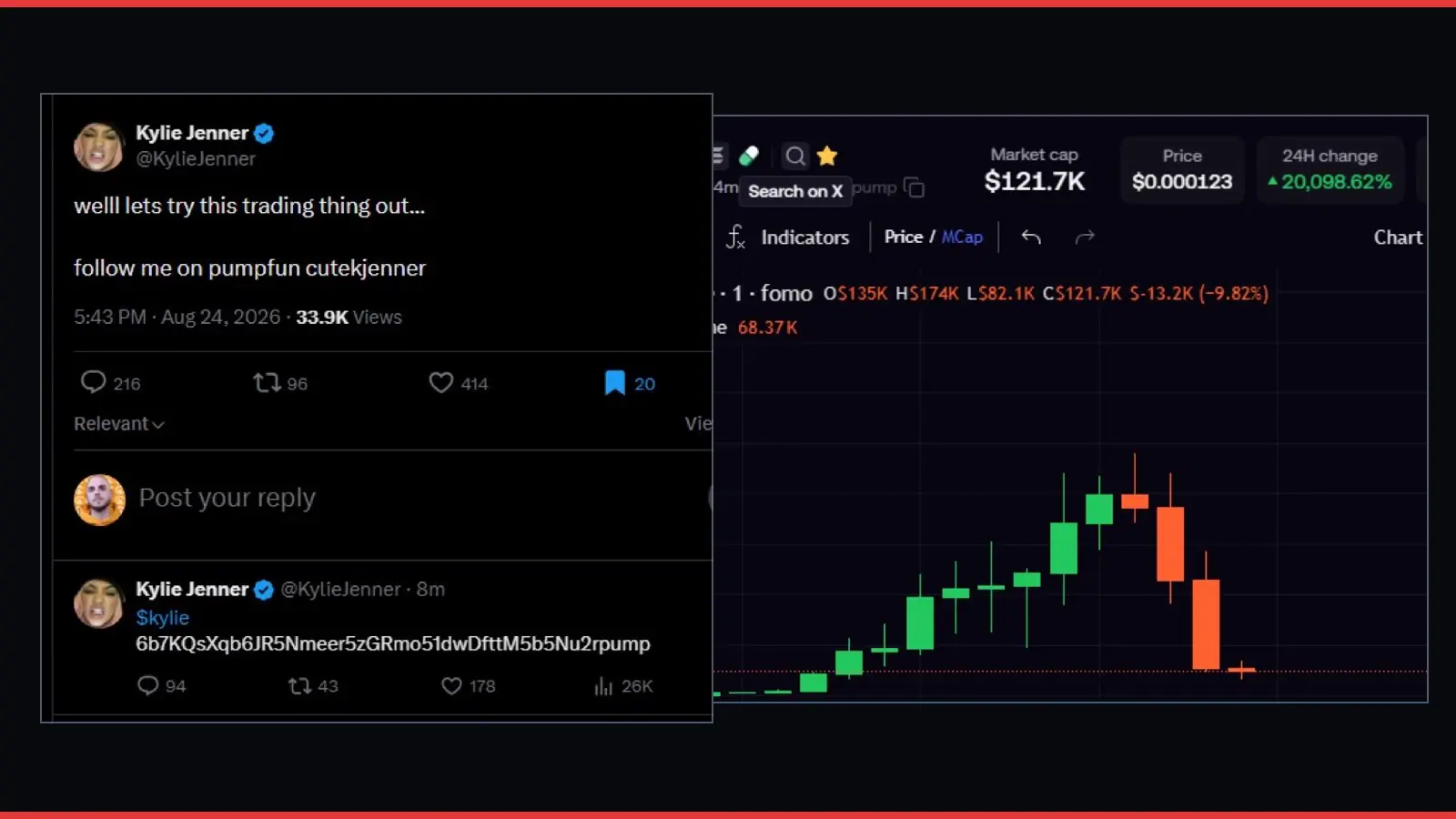
Bottom line: Kylie Jenner’s verified X account briefly posted a Pump.fun handle and a Solana token address on August 24. The posts disappeared within minutes. The token reportedly reached a market capitalization of about $1.21 million, plunged below $120,000, and continued trading through an extreme rebound and sell-off.
There is no public evidence that Jenner created the token, authorized it or profited from it. There was also no public statement from Jenner explaining the posts when this article was published. That makes “account compromise” a strong suspicion, not an established fact.
The larger story is less ambiguous. Scam coins are returning through a highly efficient distribution model: launch a token in seconds, borrow the credibility of a verified account, create a rush of buyers, and sell before the account owner or platform can respond. July produced reported incidents involving SpaceX and Starlink, Robinhood CEO Vlad Tenev and U.S. Senator Cynthia Lummis. The Kylie episode follows the same attention-to-liquidity pattern.
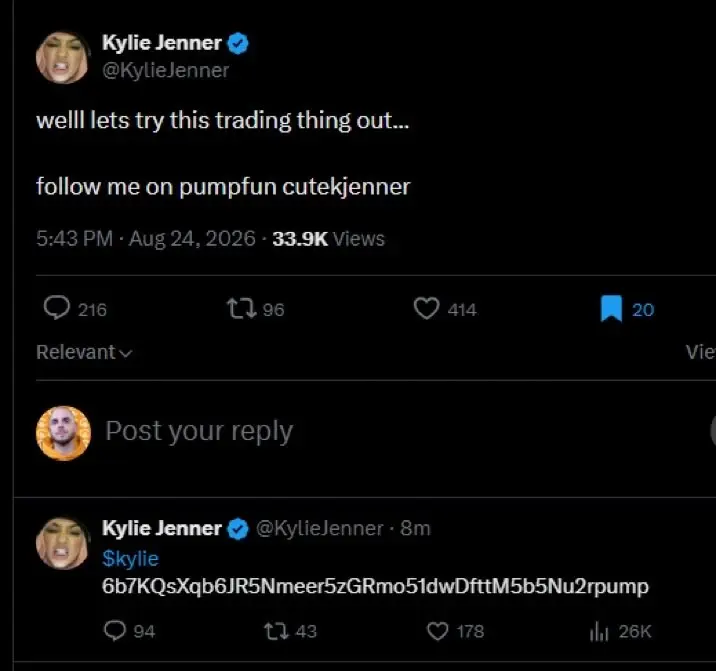
6b7K…rpump. Screenshot: @Ministerr on X.What did Kylie Jenner’s X account post?
At 5:43 p.m. on August 24, a post from the verified @KylieJenner account said it was trying “this trading thing” and directed followers to a Pump.fun profile named cutekjenner. A follow-up supplied the complete contract address for a Solana token called kylie:
6b7KQsXqb6JR5Nmeer5zGRmo51dwDfttM5b5Nu2rpump
The screenshot showed roughly 33,900 views on the first post and 26,000 on the contract-address reply. Jenner’s account had approximately 39.5 million followers, giving even a short-lived post enormous distribution.
Both posts were deleted. A contemporaneous report from Crypto Briefing said observers suspected the account had been compromised, but noted that no official explanation had been published. Boxmining independently searched Jenner’s public X posts after the deletion and found no correction or token announcement before publication.
That distinction matters. A post appearing on a celebrity’s verified account proves the account published it. It does not prove the celebrity personally wrote it, approved the token or controlled any wallet connected to it.
Celebrities are being used again to scam.
— Minister 🔮 (@Ministerr) August 24, 2026
this is crazy. pic.twitter.com/pgXKPyc4iu
What happened to the kylie token?
The token behaved like an attention-driven launch, not a market discovering the value of a working product.
| Snapshot | What the public record showed |
|---|---|
| Initial promotion | A verified celebrity account named the Pump.fun profile and posted the contract address |
| Reported peak | Market capitalization reached about $1.21 million |
| First collapse | Market capitalization fell below $120,000, a decline of more than 90% from the reported peak |
| 01:49 UTC on August 25 | The main PumpSwap pair showed about $236,000 market cap, $49,000 liquidity and $5.98 million in 24-hour volume |
The last line is a later DexScreener market snapshot, not a stable valuation. At that moment the token had bounced from its first crash but still sat roughly 80% below the reported peak. Prices, liquidity and volume can change while this article is being read.
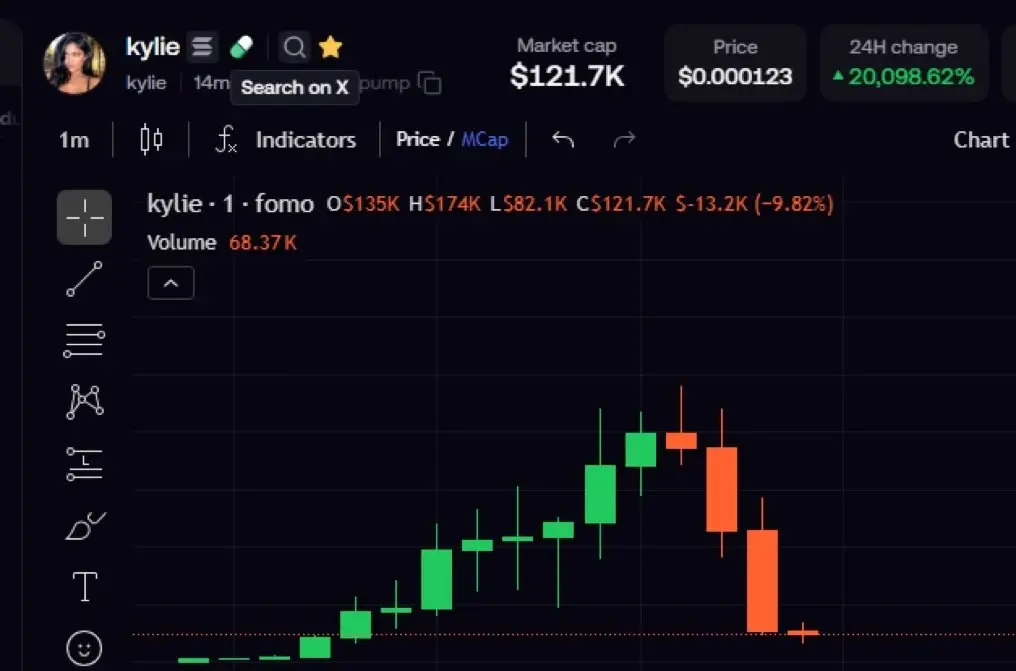
The screenshot’s +20,098% 24-hour figure is a useful warning about launch-day percentages. A token starting near zero can display an enormous gain even after most buyers from the peak are already underwater. Percentage change from the first trade does not describe the experience of someone who bought after a viral post.
Was this definitely a rug pull or an account hack?
Not yet. The public evidence supports describing this as a suspected scam-coin promotion and a suspected account compromise.
Several facts are established:
- the posts came from Jenner’s verified X account;
- they promoted a specific Pump.fun handle and contract address;
- the posts were removed quickly;
- the token rose and collapsed within the same short window; and
- no official Jenner statement, website or durable project disclosure authenticated the launch before publication.
What remains unproven is who controlled the account, who controlled the relevant token wallets, whether the promoter sold into the spike, and whether Jenner or her team authorized anything. Calling Jenner the creator or beneficiary would go beyond the evidence.
“Rug pull” also has a narrower technical meaning than “price crashed.” It usually refers to insiders removing liquidity, dumping a concentrated supply or using privileged token controls to make other holders’ positions worthless. A candlestick chart alone cannot establish which mechanism occurred. Wallet-level attribution is required.
Why scam coins are coming back
The old 2017 scam-coin playbook needed a website, a white paper and weeks of promotion. The 2026 version can compress the entire operation into one social post.
1. Token creation has become almost frictionless
Pump.fun says every new coin begins on a bonding curve before successful launches migrate into external liquidity. There is no application process that verifies a celebrity partnership before a token can exist.
The platform’s own August 22 activity page reported roughly 608,900 daily active Solana wallets, about $890,000 of daily buyback spending, and a 90-day annualized revenue run rate near $392 million. Those are Pump.fun’s figures and should be read as platform-reported metrics, but they show that the launch-and-trade machinery is active at enormous scale.
Permissionless creation is not itself fraud. The risk is that the same speed and accessibility available to legitimate communities are also available to impersonators.
2. A verified account can be converted directly into liquidity
The attacker does not need to build an audience. They only need temporary access to an account that already has one.
On July 12, the verified SpaceX and Starlink accounts reportedly amplified SCATMAN, a token on Robinhood Chain. On-chain reporting reconstructed a 575% rise in the first 20 minutes and sales worth about 73.7 ETH, or roughly $135,000, before the token collapsed.
On July 23, Robinhood CEO Vlad Tenev’s X account promoted a fake VLAD memecoin. Tenev later said a fraudster had social-engineered X customer support, bypassing ordinary protections including two-factor authentication and login notifications. That confirmed incident is important because it shows that a blue check and 2FA do not make every post authentic.
On July 29, Cynthia Lummis’s verified Senate account reportedly linked to a fake USA Token on Pump.fun. The post was removed after about five minutes; contemporaneous reporting said no losses had been identified and her office had not issued a statement at that time.
The Kylie posts arrived less than a month later. These incidents vary in quality of evidence and financial impact, but the distribution method is consistent: trusted account, new token, short window, rapid exit.
3. The correction always loses the race
A token can be created, posted and bought before a celebrity’s team notices. By the time the account is recovered, the price can already have collapsed and the post can be gone.
The correction then has to reach the same people who saw the promotion, including users who acted on screenshots, reposts or Telegram forwards. It rarely travels with the same urgency as the supposed “launch.”
This is why deletion is not a reset. The post may disappear, but the token, trades and losses remain on-chain.
4. Regulation does not turn every bad memecoin trade into an SEC case
In a February 2025 staff statement, the SEC’s Division of Corporation Finance said typical meme coins described as speculative collectibles are generally not securities and that holders are not protected by federal securities laws. The staff also stressed that fraud involving meme coins may still be prosecuted under other federal or state laws.
The practical lesson is not that memecoin fraud is legal. It is that victims should not assume the securities-law framework, disclosures or recovery paths associated with a regulated investment automatically apply.
Not every memecoin is a scam—but every surprise celebrity coin needs proof
A memecoin can be openly speculative without being fraudulent. Communities sometimes create tokens with transparent deployers, known distribution, disclosed risks and no false endorsement. The price can still collapse without anyone committing a crime.
A scam coin adds deception: a fake identity, unauthorized branding, hidden control, manipulated promotion, undisclosed insider supply or an intentional exit at the expense of later buyers.
For a surprise celebrity token, the minimum proof should include:
- confirmation on more than one official channel;
- the exact contract address published on a persistent official website;
- a clear statement of who created and controls the token;
- transparent supply, deployer and liquidity information; and
- enough time for independent verification.
If the pitch only works when you buy in the next five minutes, there is no time to establish those facts. That urgency is the warning.
How to avoid the next celebrity scam coin
- Treat every surprise token post as compromised until independently confirmed. A verified account is one signal, not proof.
- Do not buy from a screenshot or shortened link. Find the celebrity or project’s official website separately and compare the complete contract address.
- Wait for a second channel. Look for the same announcement on an official site, another long-established social account or a named representative’s statement.
- Inspect control, not just the chart. Check deployer history, holder concentration, mint or freeze authority, liquidity depth and linked wallets. Passing one automated check does not prove legitimacy.
- Do not connect a funded wallet to a link in a viral post. A token promotion can also be a wallet-drainer campaign.
- Assume a launch-day percentage is misleading. Compare the current price with the peak and check whether there is enough real liquidity to exit.
- Never pay a recovery service in advance. Victims of one crypto scam are frequently targeted again by people promising to recover the funds.
The SEC’s Investor.gov alert on crypto pump-and-dumps gives the same core warning: fraudsters can create a memecoin, promote it on social media, sell into the buying they created and leave later buyers with the collapse.
The real product is borrowed trust
The kylie token may disappear into the long tail of abandoned memecoins. The mechanism will not.
Launchpads have reduced token creation to a few clicks. Social platforms have concentrated enormous audiences behind individual accounts. On-chain markets let the attacker trade immediately and globally. Put those three systems together and a compromised login becomes a temporary liquidity event.
That is why scam coins feel like they are coming back. The fraud did not become more sophisticated at the token layer. It became faster at the distribution layer.
The safest assumption is simple: if a celebrity suddenly posts a new contract address, the burden of proof belongs to the promoter—not the buyer.
Kylie Jenner memecoin FAQ
Did Kylie Jenner launch a memecoin?
There is no verified evidence that Kylie Jenner created or authorized the kylie token. Her verified X account briefly promoted a Pump.fun handle and contract address, but the posts were deleted and no official explanation had been published when this article was written.
Was Kylie Jenner's X account hacked?
An account compromise is suspected because of the unusual token posts, their rapid deletion and the lack of an authenticated project announcement. It is not confirmed without a statement from Jenner, her team or X explaining what happened.
How much did the kylie token crash?
Crypto Briefing reported a peak market capitalization around $1.21 million followed by a fall below $120,000, a decline of more than 90%. The token later bounced and remained extremely volatile, so live figures will differ.
Are all celebrity memecoins scams?
No. A celebrity can genuinely authorize a token, and a memecoin can be openly speculative without being fraudulent. Buyers still need independent confirmation, clear control and supply disclosures, and an exact contract address from persistent official sources.
Does an X verification badge prove a crypto token is real?
No. Verified accounts can be compromised, delegated access can be abused and celebrities can be linked to products without consent. Confirm a token through multiple official channels before trusting a social post.
What should I do if I bought a suspected scam coin?
Stop sending funds, save the contract address and transaction hashes, revoke unnecessary wallet approvals, and report the incident to the relevant exchange, wallet provider and authorities. Do not share a seed phrase or pay an unofficial recovery service.
Sources and methodology
- The deleted-post screenshots and original warning came from Minister’s August 24 X post. Boxmining captured the two attached images at their original published resolution.
- Post text, timestamps, reach and account details were cross-checked against X’s public post data on August 25.
- The peak and first-collapse figures came from Crypto Briefing’s contemporaneous report.
- The later market snapshot came from the main kylie/SOL PumpSwap pair on DexScreener at 01:49 UTC on August 25.
- The broader pattern uses a confirmed Reuters report on the Tenev takeover, contemporary reporting on the SpaceX/Starlink and Lummis incidents, Pump.fun’s own activity figures, and SEC/Investor.gov primary guidance.
Evidence limit: Boxmining did not attribute control of the kylie deployer or trading wallets to Jenner or any named person. No claim that the account was hacked, that a specific wallet belonged to the promoter, or that a criminal offense occurred should be treated as established without additional evidence.
Share
Found this useful?
Share it with someone who'd want to read it.
Related

Cosmos EVM Hack Explained: How Shared Code Drained Multiple Chains
Attackers used a shared Cosmos EVM flaw to drain KiiChain and TAC and force emergency halts across several networks. The code failed, but so did the warning system around it.
Trump-Linked World Liberty Launches $4B USD1 on Canton
World Liberty Financial's USD1 is now natively issued on Canton, giving tokenized institutional markets another dollar settlement option.
What Is HKDAP? Standard Chartered's Hong Kong Stablecoin Plan
HKDAP is Hong Kong's first licensed HKD stablecoin. Here is what Standard Chartered is building, why it matters and how far the plan could go.