

Fantom in 2026: what changed with Sonic?
Fantom is the smart-contract blockchain ecosystem behind the Opera network and its FTM token. The key update for readers today is Sonic, a separate EVM-compatible layer-1 blockchain with its own S token. Sonic launched on December 18, 2024; the official launch announcement introduced a 1:1 upgrade from FTM to S. This is a move between networks, not simply a new ticker appearing in an unchanged wallet balance. Source: Sonic mainnet launch.
Status checked November 11, 2026: do not rely on the old June 30 Opera shutdown deadline. An April announcement proposed retiring Opera infrastructure, but Sonic Labs reversed that decision on June 23, 2026. Its newer statement says Opera will remain live through at least the end of 2026, with regular bridge funding during that period. That is a dated support commitment, not a guarantee that every bridge transfer is immediately available. April sunset proposal; June reversal: The First 1%.
Fantom Opera vs Sonic
| Question | Fantom Opera | Sonic |
|---|---|---|
| Native token | FTM | S |
| Relationship | Original network covered by this guide | Separate successor network launched in December 2024 |
| Existing history | Opera transactions stay on Opera | Does not inherit Opera transaction history |
| Token transition | Eligible FTM can be upgraded through the official route | S is used for fees, staking, validators and governance |
The official migration overview explains S token utility. The migration FAQ confirms that transaction history stays on the original chain and that individual applications need their own migration arrangements.
Boxmining’s take
The useful question is no longer just whether Fantom is fast. It is which network holds your assets, which applications still support them, and whether you have a supported route to Sonic. A fast chain does not remove bridge, liquidity or smart-contract risk. Treat the original explainer below as background on Fantom’s architecture, not a current checklist of available DeFi products or active partnerships.
Original Fantom explainer and historical context
The following material preserves the original guide. Its smart-city targets, product roadmap and partnership descriptions reflect that earlier period; they are not independently reconfirmed operating claims for 2026. In particular, “near-infinite” scalability and “near zero” cost are promotional descriptions, not measured guarantees.
Fantom (FTM) is a smart contract-enabled blockchain that provides a robust environment for dApp (decentralized application) development.
Using advanced Directed Acyclic Graph (DAG) technology, this project aims to provide near-infinite scalability and instant transactions at nearly zero cost. They are also working on a high-performance virtual machine with safe, secure smart contract execution.
Check out our explainer video on Fantom (FTM) will it be the next hotbed for DeFi?
The Blockchain Trilemma: What is it?
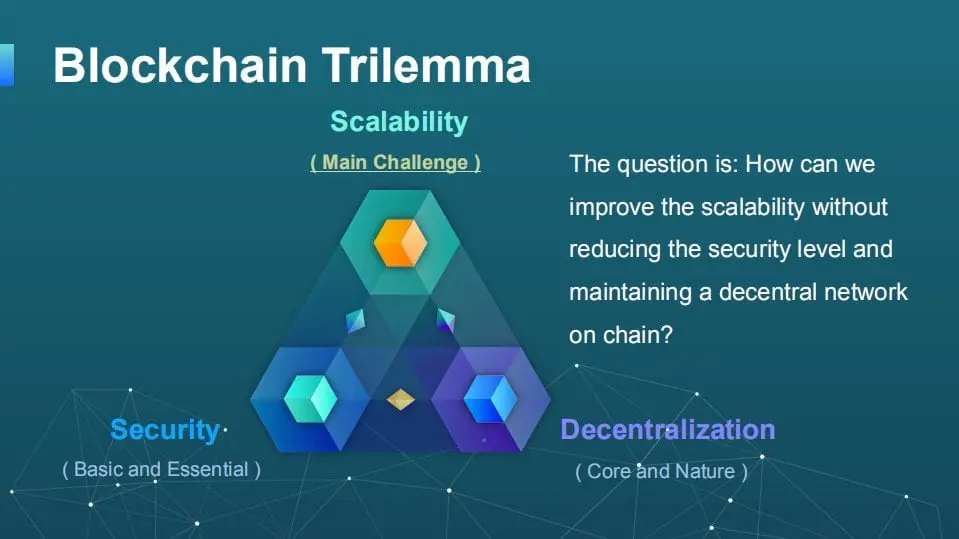
The blockchain trilemma is a concept coined by Vitalik Buterin that proposes a set of three main issues that developers encounter when building blockchains. More often than not, creators are forced to sacrifice one aspect for the sake of the other two.
- Decentralization – creating a blockchain system that does not rely on a central point of control
- Scalability – the ability for a blockchain system to handle an increasingly growing amount of transactions
- Security – the ability of the blockchain system to operate as expected, defend itself from attacks, bugs, and other unforeseen issues
For some in the industry, achieving all three aspects is an impossible feat that will never be done, at least in the near future.
Fantom is designed to overcome these limitations of old-generation blockchain platforms by providing a steady balance of scalability, security, and decentralization.
Fantom Overview
Fantom operates atop a bespoke “leaderless” PoS consensus mechanism dubbed Lachesis that secures the Fantom network and ensures both transactional speed and security. Lachesis is an aBFT consensus mechanism, which means that network data can be processed at different times, and the network can tolerate up to one third of participants engaging in faulty or malicious behavior without causing undue harm to network processes.
Lachesis also boasts near-instant finality. This means that transactions are confirmed and finalized in an average of one second, without the need to wait for laborious block confirmation as experienced in Proof-of-Work (PoW) networks. By avoiding the relatively lengthy block confirmation process, this aBFT system is much faster and more scalable than many of its Byzantine Fault Tolerant (BFT) counterparts.
The Fantom Foundation has turned its focus towards decentralized finance (DeFi) use cases with the help of Yearn Finance founder Andre Cronje, who serves as a technical advisor to Fantom. Andre has advised and helped promote Fantom’s multi-chain efforts, such as the launch of Fantom’s bridge to Ethereum.
As an ultra-high speed and high-performance platform, Fantom believes it can become the IT infrastructure backbone for the emerging smart cities. With a goal of executing 300,000 transactions per second, and the ability to communicate across multiple service providers, Fantom believes it is the solution to storing vast amounts of data securely.
It hopes to achieve this by being accessible to stakeholders for smart city data-driven smart contracts and dApp adoption. The Fantom team envisions the platform being used across a wide variety of sectors, including public utilities, smart home systems, healthcare, education, traffic management, resource management, and environmental sustainability projects.
Fantom Technology
Fantom features two core technologies:
- Lachesis protocol – the core consensus layer
- Opera – an application development layer
Lachesis uses a Directed Acyclic Graph (DAG) based algorithm to achieve asynchronous Byzantine fault tolerance (aBFT). Lachesis has four key qualities:
- Asynchronous: Participants have the freedom to process commands at different times
- Leaderless: No participant plays a “special” role in block production
- Byzantine Fault-Tolerant: Supports one-third of faulty nodes
- Near-Instant Finality: Transactions are confirmed in 1-2 seconds.
Fantom has implemented Lachesis as a consensus layer that can extend to additional layers within the system.
Opera is a permissionless and open-source environment for development. It boasts the full range of smart contract capability that Ethereum has due to its support of the Solidity programming language and integration with the Ethereum Virtual Machine (EVM). Applications built on Fantom can be designed to be interoperable with platforms built on Ethereum, while still maintaining the transactional efficiency of the Fantom network.
A proprietary software development kit (SDK) known as the Fantom Virtual Machine will eventually be released for native Fantom-based development alongside continued support for the EVM — a strategy meant to entice Ethereum-based dApp developers to make an easy transition over to building applications on Fantom.
Fantom DeFi and FTM Token
Historical product descriptions: the fMint, fLend, fTrade and collateral features below are retained from the original article, not verified as available today. Do not assume all staked FTM is liquid or usable as collateral. Consult the specific application before depositing or migrating funds.
Fantom promises to be the all-in-one DeFi (decentralized finance) suite for users. Fantom’s EVM-compatible blockchain gives users the ability to mint, trade, lend and borrow digital assets directly from their wallets. And all of this comes with near zero fees and instant transactions, making DeFi ideal on Fantom.
Fantom currently supports the following:
- Liquid staking – using staked FTM tokens as collateral for DeFi applications. All FTM delegations are liquid within the Fantom ecosystem.
- fMint – users can mint dozens of synthetic assets on Fantom, including cryptocurrencies, national currencies, and commodities.
- fLend – lending and borrowing digital assets to trade and to earn interests without losing exposure to held FTM.
- fTrade – trading Fantom-based digital assets without leaving the wallet. This makes for a fully non-custodial and decentralized AMM exchange.
What is the FTM token?
FTM is the primary token on the Fantom network. FTM tokens and sFTM tokens can be used as collateral to mint fUSD, which can then be used to trade and swap for synthetic tokens and fiat, and much more. All of this is accomplished through the progressive web app Fantom fWallet, where users can store, send, receive, and stake FTM tokens.
Fantom partnerships
Historical announcements: the relationships and adoption projections below are not evidence that these integrations or government projects remain active in 2026.
Fantom is working together with Chainlink to build secure and scalable DeFi products like decentralized stablecoins, lending protocols, and synthetic assets. All developers building on Fantom can access Chainlink’s oracle infrastructure. The integration enables the whole Fantom ecosystem to combine tamper-proof real-time data for on-chain and off-chain assets from trusted sources.
Travala, a blockchain-based travel booking platform, is leveraging Fantom to help users book over 3,000,000 travel products worldwide, including hotels, homes, flights, tours, and activities. This will be a huge boost to Fantom’s adoption.
SuperFarm, a growing NFT ecosystem, simplifies the process for builders on projects like Fantom to set up NFT farms and expand use cases for their tokens. In addition to launching exclusive NFT drops for Fantom users, SuperFarm offers Fantom builders new ways to engage their communities. By setting up NFT farms via the SuperFarm platform’s intuitive and simple interface, builders can incentivize community members to stake their tokens, earn rewards, and interact with each other.
DABS is Afghanistan’s national and fastest-growing electricity company. It manages electricity production, import, transmission, and distribution across the country. Fantom has signed an MoU with DABS where they have agreed to cooperate on the digitalization and implementation of advanced audit software within DABS’s operations. This a huge partnership to support smart energy in Afghanistan, which can help more adoption & validation of the Fantom platform.
Fantom has secured many partnerships and integrations in its quest to become the “nervous system for smart cities.”
More details about these partnerships can be found on their official website: https://fantom.foundation/partners/
Conclusion
Fantom’s approach to the DeFi and dApp landscape is innovative — as is its staking reward program structure. Further proposed use cases for Fantom’s highly scalable smart contract platform are dApps related to supply chain management, payments, and smart city programs, some of which are already being piloted around the world.
As the first of its kind with its complex and unique infrastructure, Fantom’s approach to fast, scalable dApp development is still establishing its place in the wider blockchain ecosystem. Although there is already much competition in the burgeoning dApp sector, the speed and benefits that Fantom offers dApp developers are notable, and the platform is poised to gain further traction.
FAQ: Fantom, FTM and the Sonic upgrade
Is Fantom now Sonic?
Sonic is the ecosystem’s successor network, but Opera and Sonic are distinct chains. The official upgrade converts eligible FTM into S at 1:1; it does not automatically move every token or application position in your wallet. Sonic launch details.
Can I still upgrade FTM to S, and can I reverse it?
The published migration terms allow FTM-to-S upgrades after the initial 90-day period, but no reverse S-to-FTM conversion through that mechanism. Start with the official upgrade handbook: it distinguishes FTM on Opera, Ethereum-held FTM and exchange balances. Keep FTM for gas on Opera, and check your exchange’s own supported network and migration instructions if it holds your tokens. The handbook contains launch-era incentives; do not assume those offers remain active.
Do my DeFi positions move automatically?
No. The official FTM upgrade portal does not migrate app tokens. Sonic’s migration FAQ says liquidity-provider positions require separate handling: exit the position, migrate the constituent assets through supported routes, then recreate a position if available on Sonic. Follow each project’s instructions; do not send unrelated tokens to an FTM upgrade contract.
Did Opera shut down in June 2026?
The June 23 announcement superseded the earlier June 30 shutdown plan and committed to keeping Opera live until at least year-end 2026. Check Sonic Labs’ revised announcement and subsequent notices before acting; the commitment does not establish a permanent support policy beyond that period.
For historical campaign context, see our Sonic Labs (Fantom) S token airdrop guide. Its campaign information is separate from the token upgrade and should not be read as proof of current reward eligibility.
FAQ
These original FAQ answers describe Fantom at the time of publication. Use the updated migration FAQ above for the Opera/Sonic distinction and current dated support context.
What is Fantom?
Fantom is a smart contract-enabled blockchain that provides a robust environment for dApp development.
What does Fantom do?
The Fantom network architecture intends to provide a viable solution to the blockchain trilemma by providing a steady balance of scalability, security, and decentralization.
How does Fantom work?
Fantom’s fast, scalable platform for decentralized applications (dApps) draws its speed from a unique consensus mechanism called Lachesis. Fantom also offers tools that make it easy to integrate existing dApps, a nuanced system of staking rewards, and a suite of built-in decentralized finance (DeFi) tools.
What is Lachesis?
Fantom is a Layer-1 blockchain that uses a single consensus layer to support the creation of multiple execution chains. The network’s independent consensus layer called Lachesis, featuring a novel consensus mechanism developed by the Fantom Foundation dubbed the “Lachesis Protocol.” Lachesis can provide security to multiple other layers, the first of which is Fantom’s EVM-compatible smart contract chain called Opera.
Has Fantom been adopted?
Yes. Fantom is an ambitious project that has already partnered with numerous blockchain projects, as well as governments and enterprises.
Sources:
https://medium.com/certik/the-blockchain-trilemma-decentralized-scalable-and-secure-e9d8c41a87b3 https://fantom.foundation/lachesis-consensus-algorithm/ https://fantom.foundation/what-is-fantom-opera/ https://www.gemini.com/cryptopedia/fantom-wallet-fantom-crypto-ftm-token https://messari.io/asset/fantom/profile/technology https://medium.com/geekculture/what-is-fantom-ftm-token-why-it-is-the-potential-hidden-gem-67be22a51254
https://www.coinbureau.com/review/fantom-ftm/ https://fantom.foundation/partners/?__cf_chl_jschl_tk__=pmd_qs_MOAP6cGW1uLpLEUYyT98dB0iKkE4DXjCrhQSs3Ps-1632701162-0-gqNtZGzNAdCjcnBszQo9
Share
Found this useful?
Share it with someone who'd want to read it.
Related
Aave (AAVE) Guide: V4, V3, GHO, Lending and Risks
A current guide to Aave V4 and V3, supplying, borrowing, GHO, AAVE governance, Umbrella and liquidation risk, with the original 2020 article preserved below.
Aavegotchi and GHST Guide: Base Migration, NFTs and DAO Status
A current guide to Aavegotchi NFTs, GHST, the Base migration, closed bonding curve and 2026 community-stewardship transition, with the original 2020 article archived below.
Ampleforth AMPL Guide: Rebases, FORTH, SPOT and Risks
How AMPL rebases work, why token count is not profit, and the roles of FORTH governance, wrapped AMPL, SPOT and current liquidity programs.