
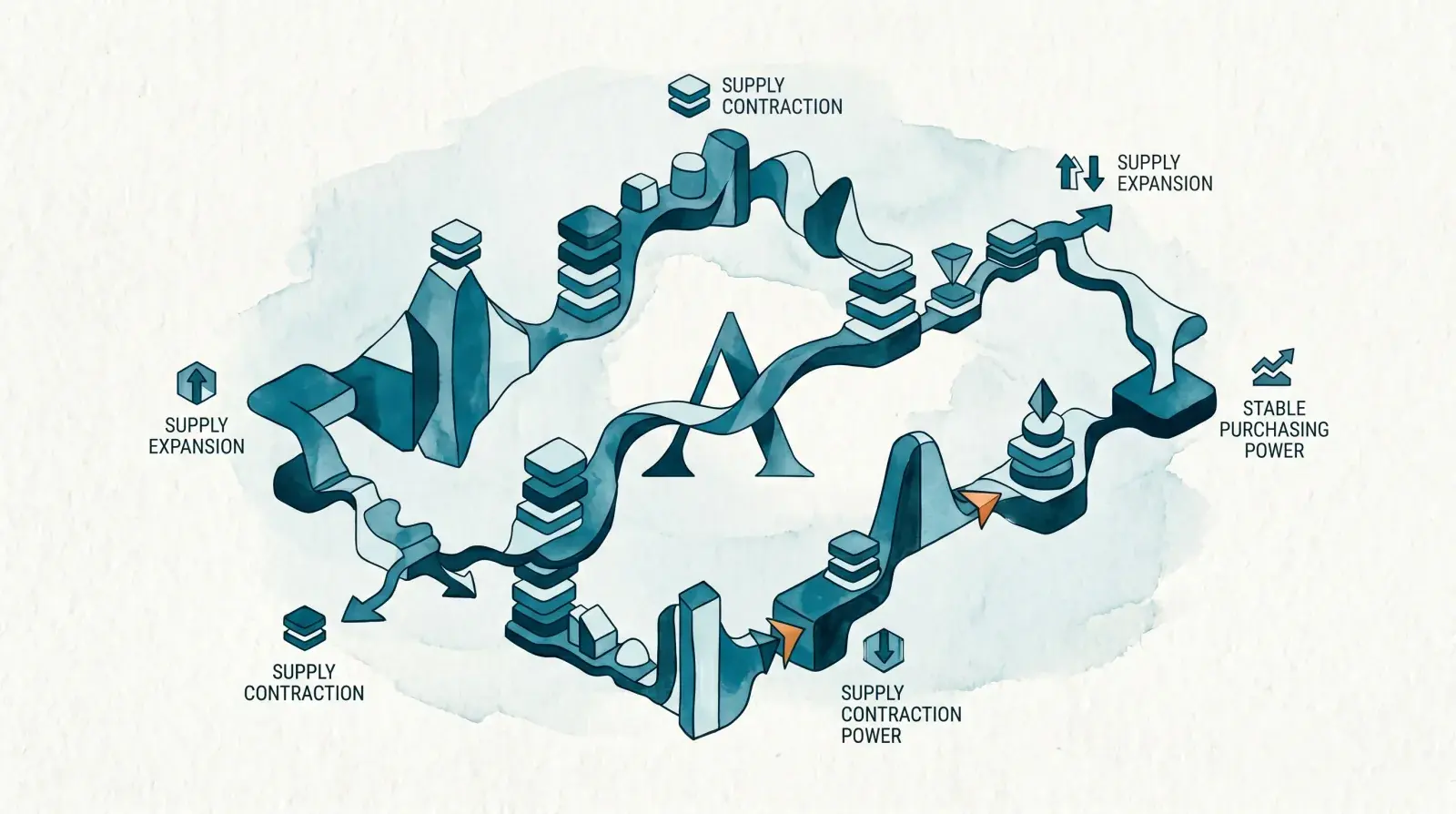
Ampleforth’s AMPL is an elastic-supply ERC-20 token. Its protocol targets the purchasing power of one 2019 US dollar adjusted by the Consumer Price Index, not a permanently fixed nominal price of exactly $1. When AMPL’s oracle price moves sufficiently outside the target band, a daily rebase proportionally changes the number of raw AMPL units associated with every address.
A rebase is not free yield. If the supply expands by 10%, each raw AMPL holder has roughly 10% more units but still owns the same percentage of the network; if supply contracts, each has fewer. The market value of a holding depends on both the number of units and the price, so positive rebases can accompany losses and negative rebases can accompany gains.
Safety warning: Wallets, exchanges and DeFi apps do not all display or account for rebasing tokens correctly. Verify the official AMPL contract, whether a platform supports rebases, the difference between AMPL and wrapped AMPL, and the exact liquidity-pool assets before transferring funds.
Ampleforth status in 2026
| Topic in the 2020 article | Current status |
|---|---|
| Target of about $1 | More precisely, the CPI-adjusted purchasing power of one 2019 US dollar |
| Rebase at 1 p.m. EST | Outdated; current documentation specifies one daily rebase at 2:00 a.m. UTC |
| $0.96-$1.06 equilibrium range | Outdated static figures; current docs describe a configurable 5% deviation threshold |
| AMPL as the protocol’s only major token | Incomplete; FORTH governs the ecosystem and SPOT is an AMPL-backed derivative |
| Geyser pays AMPL | Current Geyser programs advertise FORTH rewards and their pools can change |
| 2020 exchange list | Obsolete; one listed exchange, FTX, collapsed, and availability must be checked live |
| Foundation-control description | Historical; current governance is organized around FORTH, but users should independently review contract and governance controls |
How an AMPL rebase works
The protocol reads a volume-weighted market price through its oracle system and compares it with the CPI-adjusted target. If the deviation exceeds the configured threshold, it applies a supply adjustment through a global accounting coefficient. Users do not need to claim the adjustment or receive a normal token transfer.
Suppose a wallet owns 1% of all AMPL before a rebase and makes no trade. A proportional rebase should leave it with 1% afterward. This non-dilutive property describes relative ownership; it does not guarantee that the wallet’s dollar value, purchasing power or market liquidity stays constant.
Raw AMPL rebases. Wrapped AMPL (wAMPL) does not change the visible token balance; instead, each wrapped unit represents a changing amount of underlying AMPL. Wrapping can improve compatibility with applications that cannot handle elastic balances, but it adds wrapper-contract and integration risk.
What are FORTH and SPOT?
FORTH is the Ampleforth ecosystem’s governance token. Holders can participate in protocol parameter decisions and governance over ecosystem resources. FORTH does not rebase merely because AMPL does, and owning FORTH is not the same exposure as owning AMPL.
SPOT is a non-rebasing perpetual note backed by fully collateralized AMPL-derived assets. Its design aims to strip away most of AMPL’s supply volatility while tracking a similar CPI-adjusted reference. That design does not make SPOT risk-free or guarantee a fixed market price; it depends on its contracts, collateral structure, liquidity and governance.
Liquidity programs and Geysers
Ampleforth Geysers are incentive contracts for selected AMPL- or SPOT-related liquidity positions. Current programs advertise FORTH rewards. Pools, vaults, reward rates and eligibility can change, so the 2020 Uniswap example below should not be treated as a current instruction.
Liquidity providers face more than AMPL’s rebase behavior. They also take automated-market-maker divergence loss, pool-token, wrapper, vault, oracle, smart-contract and incentive-token risks. A high displayed APR can fall quickly or be outweighed by a decline in the deposited assets.
Main AMPL risks
- Rebase-accounting risk: unsupported exchanges, wallets or contracts may mishandle changing balances.
- Market risk: the protocol targets long-run price behavior; it does not guarantee immediate redemption at the target.
- Supply-contraction risk: a negative rebase reduces raw AMPL units in a wallet.
- Oracle risk: incorrect or manipulated price inputs can cause an inappropriate supply adjustment even if proportional ownership is preserved.
- Liquidity risk: AMPL, wAMPL, FORTH and SPOT markets can have different and limited depth.
- Integration risk: lending markets, bridges, pools and accounting software may make incorrect assumptions about token balances.
- Smart-contract risk: rebasing, wrapping, tranching, Geyser and SPOT contracts can contain vulnerabilities.
- Governance risk: FORTH governance can change parameters and ecosystem decisions.
Original July 2020 Ampleforth guide (historical archive)
The original author-written sections below are preserved substantially intact. Its nominal $1 framing, rebase time and band, AMPL-paid Geyser, exchange list, price, pool balances and governance description reflect 2020. The obsolete external price-widget script was removed during the import cleanup.
Ampleforth is a game changer that is claiming the spotlight on Decentralised Finance (DeFi) following the success of several lending platforms such as Compound ($COMP), Aave ($LEND), dYdX, etc. Ampleforth is a DeFi protocol that aims to reinvent money both within and beyond the cryptocurrency space. While centralized finance (CeFi) and DeFi as we know today have their own unique sets of problems, the Ampleforth protocol is here with the aim to address them.
The protocol has a native token known as $AMPL. It is a stable currency that has both inflationary and deflationary capabilities designed to adapt to demand.
Background
Ampleforth was created by Evan Kuo, an engineering graduate of UC Berkley. He was also the former CEO of Pythagoras Pizza, the first pizzeria to tokenize its franchise.

Kuo’s motivation for creating Ampleforth was twofold. The death of his father, which made him want to leave a legacy after his passing, and his passion for tech and finance which brought him into the cryptocurrency industry.
He recognised two things that cryptocurrency was trying to reinvent: money and banking. Of the two, money was a lot easier to work with and so that became his focus.
The Ampleforth Foundation was then funded by Pantera Capital, True Ventures, Huobi exchange and Brian Armstrong. Most of the members of the foundation consist of “engineers, academics, investors, and enthusiasts” from Ivy League universities.
Ampleforth raised a total of nearly $10 million USD in 2 Initial Coin Offerings (ICO) and an Initial Exchange Offering (IEO).
Ampleforth Protocol
Ampleforth Protocol is a cryptocurrency ecosystem built on the Ethereum blockchain. What makes it stand out is its adaptive supply, that is to say, Ampleforth adjusts the circulating supply according to demand.
When the demand for Ampleforth increases, the supply increases. Conversely, when demand decreases, the supply also decreases. This makes Ampleforth prone to being mistaken as a stablecoin since it does function quite similarly.
However, it is not backed by any cryptocurrency or fiat currency like most stablecoins are. And although the system attempts to keep the value close to $1 USD, sometimes it could go way past $3 USD depending on the demand.
As of press time, $AMPL is trading at $1.64 USD according to Coin Market Cap.
The Ampleforth Protocol is autonomous, but not decentralized. The Foundation still holds the keys to the system, and have the power to freeze all assets or change token supply arbitrarily. So for some decentralization purists, this is a red flag.
Ampleforth Monetary Policy
Kuo came up with Ampleforth’s economic design after examining the history of the U.S. Dollar. Back in the day, every U.S. Dollar bill was backed by gold bullions, which were stored in government vaults. Gold is a great store of value but it has an inflexible supply. Furthermore, going by the gold standard alone runs the risk of runaway deflation.
After World War II, the Dollar was in high demand globally and the U.S. couldn’t keep up. The amount of gold is fixed since mining can only introduce very small amounts of new gold in a given timeframe. Therefore, the U.S. government decided to abandon the gold standard to avoid stagnation of international trade.
And that became the birth of the fiat U.S. Dollar, which we now know has its own set of shortcomings. One problem with fiat money is that you could only print more of them but not destroy them. Therefore, the supply can only be partially controlled in a sense. Furthermore, the people in charge of the minting facility is also subject to greed and corruption.
Ampleforth’s monetary policy is a solution to both fiat and gold-backed currencies since it is designed to maintain a stable value by adjusting the supply to match demand.
As an illustration, say you have 1 AMPL worth $1 in your wallet. If the demand for AMPL rises and causes the price to jump to $2, the Amplforth Protocol will expand the supply of AMPL such that you’ll end up with two AMPL in your wallet worth $2. This process is called a “rebase”.
The rebasing process does not dilute existing token holders. You get to retain the same percentage of the total supply yet the value you held doubled.
Ampleforth use cases
Ampleforth divides its use cases based on its goals: near term, medium term and long term use cases. In the near term, AMPL aims to diversify cryptocurrency portfolios. Most cryptocurrencies are correlated to Bitcoin’s price pattern, which poses a risk. But because of AMPL’s rebase mechanism, it is decoupled from Bitcoin’s price pattern and allows cryptocurrency traders to have some diversity in their portfolio.
In the medium term, Ampleforth aims to work as a stable store of value or form of collateral for decentralised banks and DeFi applications. This is because unlike fiat-backed stablecoins, it does not pose the risk of devaluation of its underlying asset.
Ultimately, Ampleforth hopes to become a “A better Bitcoin”. It wants to be an alternative to central-bank money that can adapt to sudden shocks in the market. In that sense, it is competing with Bitcoin and XRP; not to mention national currencies. But as of the moment, it is being used primarily in the cryptocurrency space.
Another opportunity it offers is arbitrage. Arbitrage traders have the chance to reap profits during the time the supply is reduced when the price rises. On the other hand, they can increase their AMPL allocation before the supply is increased when the price drops.
How the Amplforth ($AMPL) rebase process works
The supply of Ampleforth adjusts daily every 1pm EST to match the demand via a smart contract. The system utilizes Chainlink’s oracle network alongside the Ampleforth oracle to siphon price data from KuCoin and Bitfinex.
The smart contract ensures that Ampleforth sticks within the designated equilibrium range, which is between $0.96-$1.06. If the price of AMPL hits beyond the two extremes, the smart contract will continue to “expand” or “contract” accordingly until the value of the token is in the equilibrium range again.
Ampleforth Geyser: What is it?
Ampleforth Geyser is a smart faucet that incentivizes liquidity providers to supply AMPL to a Uniswap pool. It is brought about through a collaboration between the Ampleforth Foundation and Uniswap.
Users are rewarded with AMPL tokens for depositing AMPL to Uniswap. The longer the tokens are held in the pool, the higher the returns.
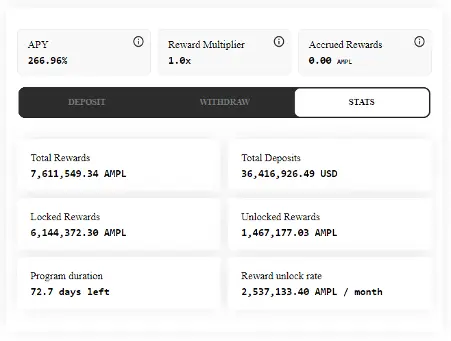
To make money from Geyser, visit their web portal at ampleforth.org/geyser and connect either your MetaMask or Coinbase wallet. You will need to deposit equal amounts of ETH and AMPL to participate.
How do I get AMPL tokens?
Aside from getting AMPL tokens during the rebase process (though this requires you to stake some AMPL in the first place), people can also buy AMPL from cryptocurrency exchanges. Here are the major exchanges that offer AMPL tokens for sale: Uniswap (v2), KuCoin, FTX exchange and Bitfinex. Learn more about our picks for the top best cryptocurrency exchanges of 2020.
Conclusion
Ampleforth has to some degree successfully redesigned the way money works despite only being a few years old. Their influence has not penetrated a huge portion of the market as of yet but there is a lot of room for them to grow. And being part of the DeFi movement makes it a lot easier to gain more traction. As a matter of fact, over 36 million AMPL has been deposited in Geyser as of now. This is a great stepping stone for the protocol.
Ultimately, Ampleforth’s goal is to compete against national currencies, and perhaps against Bitcoin as well, to become the world currency. For now, Ampleforth should work on establishing its trust and legitimacy within the cryptocurrency community, which will be a stepping stone for it to achieve its use-cases.
Decentralised Finance (DeFi) series: tutorials, guides and more
With content for both beginners and more advanced users, check out our YouTube DeFi series containing tutorials on the ESSENTIAL TOOLS you need for trading in the DeFi space e.g. MetaMask and Uniswap. As well as a deep dive into popular DeFi topics such as decentralized exchanges, borrowing-lending platforms and NFT marketplaces
The DeFi series on this website also covers topics not explored on YouTube. For an introduction on what is DeFi, check out Decentralized Finance (DeFi) Overview: A guide to the HOTTEST trend in cryptocurrency
Tutorials and guides for the ESSENTIAL DEFI TOOLS:
- MetaMask Guide: How to set up an account? PLUS tips and hacks for advanced users
- Uniswap review and tutorial: Beginners guide and advanced tips and tricks
- Serum DEX guide and review
- SushiSwap ($SUSHI) explained
- 1inch Exchange, Mooniswap and Chi GasToken: The ultimate review and guide
More videos and articles are coming soon as part of our DeFi series, so be sure to SUBSCRIBE to our Youtube channel so you can be notified as soon as they come out!
Disclaimer: Cryptocurrency trading involves significant risks and may result in the loss of your capital. You should carefully consider whether trading cryptocurrencies is right for you in light of your financial condition and ability to bear financial risks. Cryptocurrency prices are highly volatile and can fluctuate widely in a short period of time. As such, trading cryptocurrencies may not be suitable for everyone. Additionally, storing cryptocurrencies on a centralized exchange carries inherent risks, including the potential for loss due to hacking, exchange collapse, or other security breaches. We strongly advise that you seek independent professional advice before engaging in any cryptocurrency trading activities and carefully consider the security measures in place when choosing or storing your cryptocurrencies on a cryptocurrency exchange.
Frequently asked questions
What is AMPL?
AMPL is an elastic-supply ERC-20 token whose protocol targets the CPI-adjusted purchasing power of one 2019 US dollar by proportionally changing raw token balances.
Is AMPL a stablecoin?
AMPL targets a stable long-run unit of account, but its market price can deviate and its supply changes. It is not redeemable for a fixed dollar held by a custodian.
What time does AMPL rebase?
Current Ampleforth documentation says the protocol rebases once daily at 2:00 a.m. UTC, and adjusts supply only when price deviation exceeds the configured threshold.
Does a positive AMPL rebase create profit?
Not automatically. A positive rebase increases raw units proportionally but does not increase a holder's share of the network. Profit or loss also depends on market price and liquidity.
Can an AMPL balance decrease?
Yes. A negative rebase proportionally reduces raw AMPL balances when the protocol's conditions for contraction are met.
What is wrapped AMPL?
wAMPL is a non-rebasing wrapper. Its visible unit count stays fixed while the amount of underlying AMPL represented by each wrapped unit changes.
What is FORTH?
FORTH is the Ampleforth ecosystem's governance token. It is separate from AMPL and does not inherit AMPL's rebasing balance behavior.
What is SPOT?
SPOT is a non-rebasing perpetual note backed by fully collateralized AMPL-derived assets. It aims to reduce supply volatility but still carries contract, collateral and market risks.
Do Ampleforth Geysers still pay AMPL?
Current Geyser pages advertise FORTH incentives for selected AMPL- or SPOT-related liquidity positions. Programs and reward rates can change.
What are the main risks of AMPL?
Risks include supply contractions, price deviation, thin liquidity, oracle errors, unsupported wallet or exchange accounting, smart-contract bugs and governance changes.
Sources and further reading
Share
Found this useful?
Share it with someone who'd want to read it.
Related

Aave (AAVE) Guide: V4, V3, GHO, Lending and Risks
A current guide to Aave V4 and V3, supplying, borrowing, GHO, AAVE governance, Umbrella and liquidation risk, with the original 2020 article preserved below.

Aavegotchi and GHST Guide: Base Migration, NFTs and DAO Status
A current guide to Aavegotchi NFTs, GHST, the Base migration, closed bonding curve and 2026 community-stewardship transition, with the original 2020 article archived below.

Balancer Finance Guide: V3 Pools, BAL, Risks and V2 Status
How Balancer V3 pools, the Vault, routers, hooks and boosted liquidity work, plus BAL governance, the V2 sunset and the November 2025 exploit.