
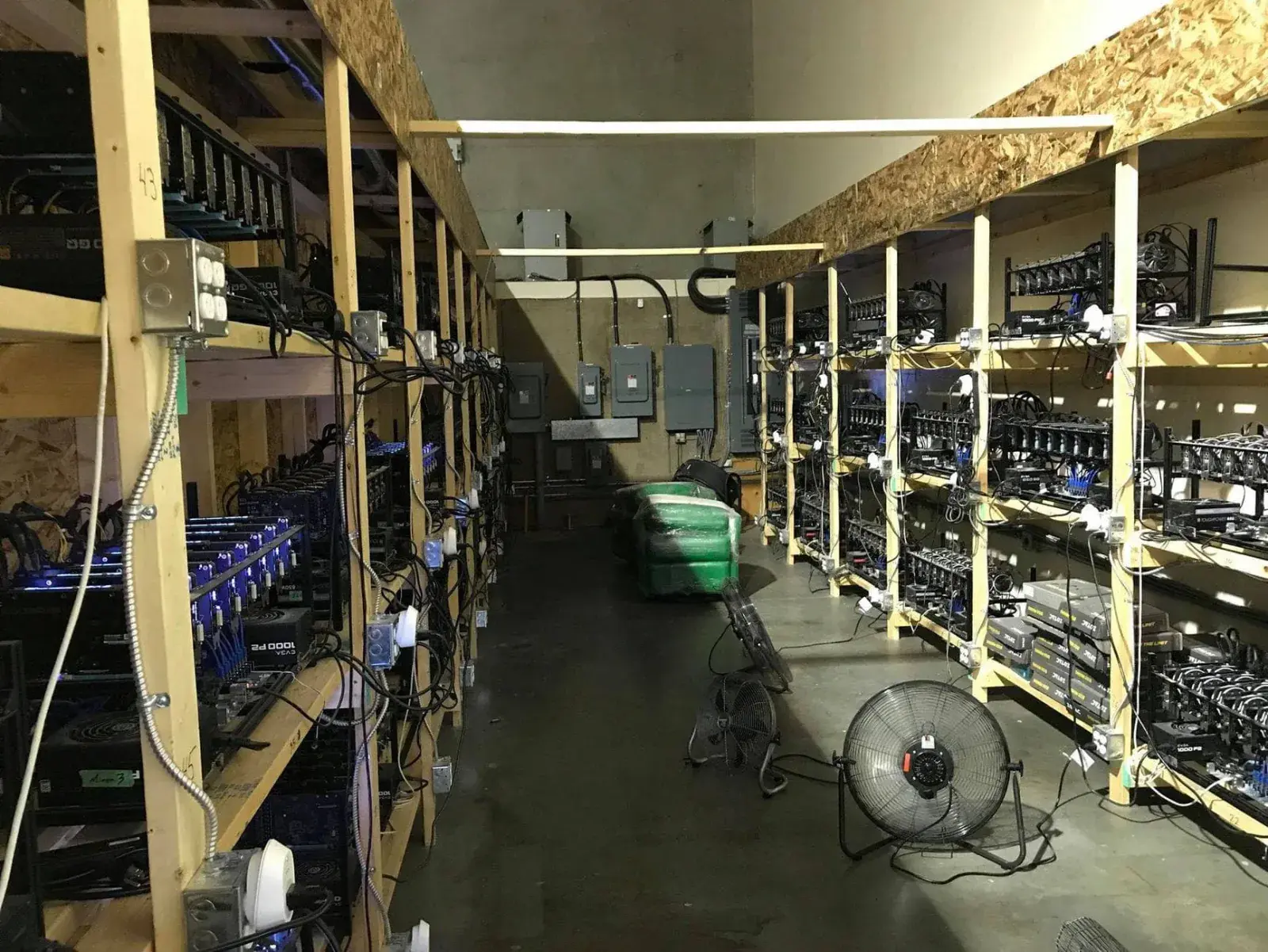
What cryptocurrency mining looks like in 2026
Cryptocurrency mining is the use of computing hardware to perform proof-of-work and compete to add valid blocks to a blockchain. A miner's revenue can include a protocol block subsidy and transaction fees, while costs include hardware, electricity, cooling, pool fees, maintenance, downtime and taxes.
The 2019 interview below captures a real 300-GPU operation from the Ethereum-mining era, but its coin and hardware advice is historical. Ethereum switched off proof-of-work mining at The Merge on 15 September 2022. A GPU can no longer mine ETH on Ethereum Mainnet.
| Network | Mining status in 2026 | Typical hardware |
|---|---|---|
| Bitcoin | Proof-of-work remains active; miners earn the 3.125 BTC block subsidy plus transaction fees | SHA-256 ASICs |
| Ethereum | Mining ended at The Merge; validators now use proof-of-stake | No ETH mining hardware |
| Monero | Proof-of-work remains active using RandomX | CPUs are generally more efficient than GPUs |
| Ravencoin | Proof-of-work remains active using KAWPOW | Consumer GPUs |
This table does not establish profitability. Network difficulty, coin price, block rewards, transaction fees and competing hash rate change, while power contracts and hardware prices are local. A machine that produces coins can still lose money.
ASIC, GPU and CPU mining compared
- ASIC mining: application-specific machines perform one algorithm efficiently. Bitcoin mining is ASIC-dominated. The trade-off is high efficiency versus limited alternative use and rapid loss of competitiveness.
- GPU mining: graphics cards can switch among compatible algorithms and may have resale value, but the end of ETH mining removed the market's former anchor. Older GTX 1070 Ti and 1080 Ti advice should not be used as a 2026 buying list.
- CPU mining: some algorithms intentionally favor general-purpose processors. Monero's RandomX is optimized for CPUs, although consumer participation does not guarantee a profit.
“ASIC resistant” is a design objective, not a permanent guarantee that specialized hardware can never gain an advantage. Hardware selection should start with the exact current algorithm and benchmark, not a coin name copied from an old mining guide.
Solo mining versus pool mining
In solo mining, one miner receives the full eligible block reward when it finds a block, but payouts are highly variable and may be extremely rare. In pool mining, participants submit shares proving contributed work and receive smaller, more frequent payouts under the pool's reward method.
A pool reduces payout variance; it does not change the expected network revenue before fees and operational differences. Pool users also take operator, payout, server, censorship and concentration risks. Verify the minimum payout, fee, reward scheme, server location and whether the pool allows miners to construct block templates or select transactions.
How to calculate mining profitability
A useful estimate starts with expected daily coin revenue, then subtracts every cash cost:
Estimated operating profit = mined coins × realizable price − electricity − pool fees − cooling − hosting − maintenance − taxes.
Capital payback must also account for the hardware purchase, power distribution, racks, networking, ventilation, repairs and eventual resale or disposal. Stress-test at a lower coin price, higher difficulty, lower uptime and higher electricity rate. A calculator showing a short payback period from today's inputs is not a promise.
Pre-purchase checklist
- Confirm the network still uses proof-of-work and the intended algorithm.
- Measure wall-plug power for the complete system rather than relying only on a chip specification.
- Obtain the all-in electricity price, including demand charges and taxes.
- Check the circuit, breaker, cable and power-supply ratings with a qualified electrician.
- Budget for airflow, noise, dust, humidity and heat rejection.
- Model pool fees, stale shares, downtime and payout thresholds.
- Check local zoning, fire, environmental, utility and tax obligations.
- Plan how the equipment will be repaired, resold or recycled.
Is cloud mining a scam?
Cloud mining is not automatically fraudulent, but the buyer often accepts price, difficulty, counterparty and contract-termination risk without controlling the hardware. Some offerings have been outright scams or have sold more hash power than they owned. The SEC and CFTC specifically warn that fake mining-farm websites may promise high guaranteed returns with little or no risk.
Red flags include guaranteed daily returns, anonymous operators, no verifiable facility or machine inventory, unclear electricity costs, mandatory reinvestment, referral-heavy compensation, withdrawal fees invented after deposit and returns paid in an illiquid in-house token. Remote hosting—where a customer owns identifiable equipment in a third-party facility—is a different arrangement, but still requires insurance, access, uptime, repair and contract diligence.
Mining safety and operational risks
- Electrical and fire risk: continuous high loads can expose inadequate wiring, connectors and breakers.
- Heat and noise: a profitable electrical input becomes almost the same amount of heat that must be removed.
- Malware risk: unofficial miners, firmware and overclocking tools can steal keys or redirect hash rate.
- Hardware risk: fans, risers, power supplies and boards fail, while new models can make existing equipment uneconomic.
- Network risk: difficulty, reward rules, algorithms and exchange support can change.
- Market risk: mined coins can fall faster than costs can be reduced.
- Legal risk: power use, noise, heat, imports, taxes and business licensing are jurisdiction-specific.
Original November 2019 miner interview (archived)
The interview below is preserved as the participants' original account. Its software, coins, GPUs and profitability examples are not 2026 recommendations. The EOS/Cardano “attack” answer is an unverified quote and should not be read as a technically demonstrated proof-of-work attack.
Cryptocurrency Mining can be tough to get started with – but there are always mining expert’s who are willing to lend a hand and share their wealth of experience. One such person is Alex Hillman, he runs cryptocurrency mining farm with over 300 GPUs. We asked detailed questions about how he got started, his mining setup and what advice he would give to beginners getting started with mining.
Miner Bio: Alex Hillman

Can you tell us about your mining operation (Where/ How many people are involved / Power usage)
When the technology started taking off I knew it was something I wanted to be involved in with my computer and programming back ground. We currently run well over 300 gpus at 3 locations including dedicated warehouses and research labs.
What type of setup – solo or pool mining do you use
We tri or quad mine all of our gpu miners. Often we mine coins like Ethereum or Raven while dual mining something like LBRY or DECRED on the GPU extra memory. We accomplish this most cases with Claymore Miner. On the CPU we use a xmr-stak style miner to mine coins like Loki, Monero or Sumocoin.
Last you can mine on pools that create extra tokens and with the fpga cards we do this as well.
We mine on large pools like ethermine with a private
workgroup of about 50 clients and friends to increase profits and luck factor.
Do you use ASICs ?
No we strongly disagree with the logistical cycle and ethics of building single use products like this that have such a short life span.
Mining is Loud and Hot – have you ever been driven crazy by the noise or Danced around naked when setting up gear?
I often jam while building but we try to do all of our
thoughtful work away from the computers. But yes I have danced naked in the
mines many times.
What do you think is the biggest challenge when it comes to mining
Having enough power to grow
Do you ever dabble in speculative mining – if so what new coins are you into
Yes spec mining can be wildy profitable. At the start we
mined sumocoin about several hundred a week at 0.07 cents. We sold those coins
at 14.00usd so it paid for our first dedicated miners.
What happens when hardware breaks ? who repairs them?
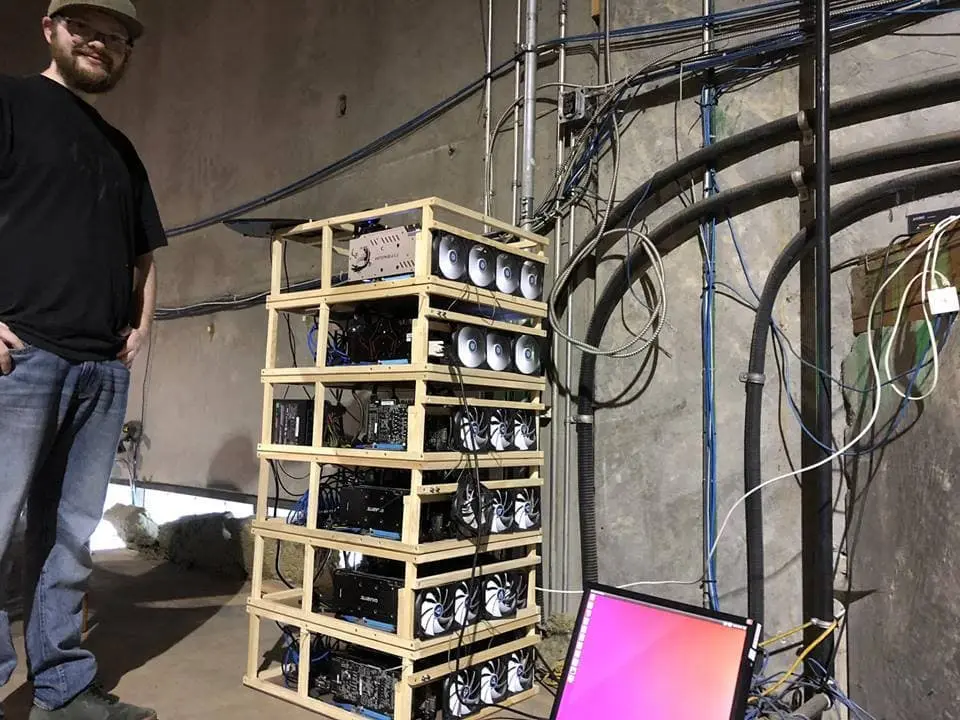
Spencer my business partner is the expert on trouble shooting most often its a software driver issue or a hardware issue like usb or risers going bad.
What is the most controversial thing to happen to you?
We helped attack the EOS and ADA blockchain with our GPU network in a effort to prove their lacking security.
What advice would you give to a someone who wants to start out mining
Start simple with a single computer at home. Use a gaming or work computer toss a good video card like a Nvidia 1070Ti or Nvidia 1080ti in it and start speculative mining first.
Nvidia or AMD – which team are you on?
Nvidia produces coins at a more efficent power rate and with
far less loss and heat. Its really not a question amd is cheap and quick while
Nvidia is the better option over time
Cloud Mining – in your opinion are they legit or scam
All a scam…. why would I rent you my money tree for any
money less than it makes me. The business model is flawed from the start.
Remote hosting is a thing but in most cases if someone is trying to rent you
cloud mining they are hedging out their own risk by making you take it all.
Frequently asked questions
Can you still mine Ethereum in 2026?
No. Ethereum Mainnet replaced proof-of-work with proof-of-stake at The Merge on 15 September 2022, so ETH mining is no longer valid block production.
Can you mine Bitcoin with a GPU?
A GPU can compute SHA-256, but it is not competitive with modern Bitcoin ASICs. Practical Bitcoin mining uses application-specific hardware.
What is the Bitcoin mining reward in 2026?
The block subsidy is 3.125 BTC following the 2024 halving. A successful block also pays the transaction fees included in that block.
Which cryptocurrencies can still be GPU mined?
Ravencoin remains a prominent example using KAWPOW. Mineable networks and algorithms can change, so verify the project's current consensus rules before buying hardware.
Can Monero be mined with a CPU?
Yes. Monero uses RandomX, which is optimized for general-purpose CPUs. Profitability still depends on hash rate, electricity, difficulty and XMR price.
Is solo mining better than pool mining?
Solo mining offers the full reward but very high payout variance. A pool distributes smaller, more regular payments based on contributed work and charges fees or creates operator risk.
How much electricity does a mining rig use?
It depends on the complete machine and settings. Measure power at the wall and include power supplies, fans, networking and cooling rather than relying on a GPU or ASIC headline rating.
Is cryptocurrency mining profitable?
It can be, but no setup is inherently profitable. Revenue varies with coin price, difficulty, fees and uptime, while power, cooling, maintenance and hardware depreciation reduce returns.
Is cloud mining legitimate?
Some companies provide real hash-rate contracts, but the model is high-risk and has also been used for fraud. Avoid guaranteed returns and verify machines, facilities, costs, ownership and withdrawal terms.
What is the safest way to start mining?
Research one current proof-of-work network, benchmark hardware you already own where appropriate, measure wall power, use official software and avoid buying equipment until a conservative cost model works.
Sources
- Ethereum.org: The Merge and the end of ETH mining
- Ethereum.org: historical proof-of-work mining documentation
- Bitcoin developer guide: solo, pool and ASIC mining
- Bitcoin Core block-reward construction (subsidy plus fees)
- Monero Project mining guide
- Monero Project: RandomX
- Ravencoin: KAWPOW and GPU mining
- SEC and CFTC warning about fraudulent mining-farm investment sites
- SEC cloud-mining fraud enforcement example
Share
Found this useful?
Share it with someone who'd want to read it.
Related
Bitcoin Mining Guide (2026)
Bitcoin Mining is the process of using specialized computer hardware to earn Bitcoin .

The Flippening: Will Ethereum Overtake Bitcoin in 2026?
The concept of the “Flippening” has been increasingly gaining traction in the crypto space.

The 4-Year Bull Cycle in Bitcoin Isn’t in Play This Time
For years, the crypto community has lived and died by one sacred chart: the Bitcoin halving cycle.