
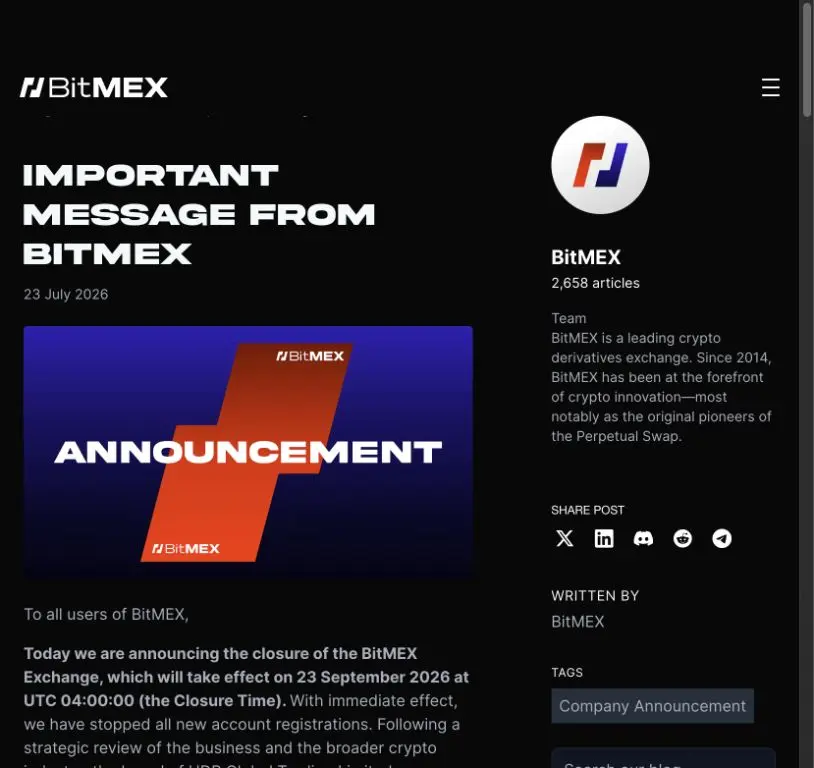
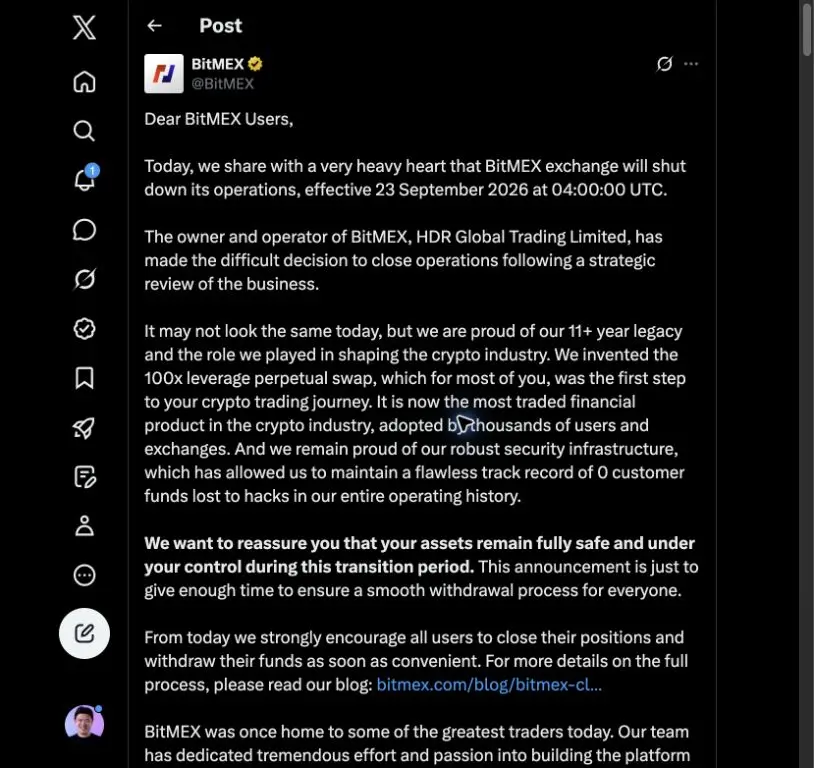
BitMEX will close its exchange on 23 September 2026 at 04:00 UTC. The decision was announced by HDR Global Trading Limited, BitMEX's owner and operator, following what the company described as a strategic review of the business and the broader crypto industry.
Status checked 13 August 2026: BitMEX's official closure notice and exchange banner still show the same 23 September deadline. The exchange has not announced a reversal. Users should continue to follow the official wind-down timetable rather than wait for the final day.
The closure ends an 11-year run for one of crypto's earliest and most influential derivatives venues. BitMEX says the platform will operate normally until the wind-down milestones begin, but users should not treat the September deadline as a reason to wait: the company is strongly urging customers to close open positions and withdraw their assets as soon as practical.
Key points at a glance
- Closure time: 23 September 2026, 04:00 UTC.
- New accounts: BitMEX has stopped new account registrations with immediate effect.
- Trading restrictions: From 26 August 2026, 04:00 UTC, the exchange says it will apply risk limits that prevent users from opening new positions; users will only be able to reduce positions.
- Position wind-down: BitMEX says it may force-close open positions from that point to ensure an orderly wind-down. Any positions still open at the closure time will be immediately force-closed.
- Withdrawals: Users will still be able to log in after the closure time to view balances and withdraw assets, but the company is asking users to withdraw before then.
- Unwithdrawn balances: KYC-verified users who leave assets on the platform after the closure time will be charged a monthly account fee equal to the greater of US$50 equivalent or 1% per annum on the remaining balance, according to the announcement.
- BMEX: The exchange says it has unstaked all staked BMEX tokens, making them immediately available in holder accounts.
What BitMEX says will happen next
BitMEX says it will continue providing normal exchange services before the closure date, subject to the planned August risk limits. It also says it will use early-settlement procedures for contracts with limited liquidity and may impose additional withdrawal reviews while the platform winds down.
Those additional checks matter. BitMEX warned that exchange closures can attract phishing attempts and said it does not offer priority or accelerated withdrawals. A withdrawal marked Processing is queued for on-chain processing; the company notes that network conditions, including Bitcoin confirmation times, can slow completion.
The company states that assets exceed liabilities on its Proof of Reserves and Liabilities page. That is BitMEX's representation, rather than an independent assessment by Boxmining.
Why is BitMEX closing?
BitMEX has not disclosed a detailed financial reason for the shutdown. Its official explanation goes no further than saying the board made the decision after a “strategic review of the business and the broader crypto industry.” However, the available evidence strongly supports a more specific conclusion: BitMEX lost the liquidity and market position that once made it one of crypto's dominant exchanges, while competition and regulatory costs kept increasing.
BitMEX's market share collapsed
In January 2020, BitMEX still handled 28% of Bitcoin perpetual-swap trading volume among the seven exchanges tracked by CoinGecko. By October, that share had fallen to 11%. Binance Futures moved in the opposite direction, reaching 39%, while Bybit also gained ground.
CoinGecko's October 2020 report connected the sharpest part of that decline to the US civil and criminal cases announced against BitMEX and its founders. More than US$337 million in Bitcoin left the platform after the charges, and CoinGecko's assessment was that many users migrated to Binance and Bybit.
Recent volume was tiny beside the market leaders
On the CoinGecko derivatives snapshot reviewed on 23 July 2026, BitMEX was around 34th by open interest and reported only about US$120 million in 24-hour trading volume. Daily figures fluctuate, so that number should be treated as a snapshot rather than a permanent total. The significant point is the scale: BitMEX was no longer close to the major derivatives venues.
This was not simply a case of the entire perpetual-futures market disappearing. The top 10 centralized perpetual exchanges processed US$12.7 trillion in Q2 2026. That was 10% lower than Q1, but still a vast market. BitMEX was absent from the top group while liquidity remained concentrated on exchanges such as Binance, OKX, Bybit, Gate and Bitget.
The spot-trading expansion did not rebuild the business
BitMEX launched spot trading in May 2022 in an attempt to expand beyond its derivatives niche. The new product failed to build meaningful momentum. Kaiko found that BitMEX's average daily spot volume fell from US$3.3 million in 2022 to roughly US$600,000 in 2023, despite zero-fee promotions.
Other parts of the expansion strategy also struggled. BitMEX abandoned a planned acquisition of German bank Bankhaus von der Heydt in 2022 and cut roughly one quarter of its workforce. At the time, the company was openly trying to return to the top 10 exchanges by volume.
Competition copied BitMEX's invention and improved the package
BitMEX's defining product—the perpetual swap—became an industry standard rather than a lasting competitive moat. Binance, OKX and Bybit paired perpetual contracts with broader asset coverage, stablecoin-settled markets and much larger spot ecosystems. More recently, Hyperliquid and other perpetual DEXs attracted traders looking for on-chain custody and greater transparency.
CoinGecko found that perpetual DEXs grew from about 2% of volume across the leading platforms through most of 2024 to a peak of 12% in November 2025. BitMEX was therefore being squeezed by larger centralized exchanges and a new generation of decentralized competitors at the same time.
Regulatory penalties made the decline more expensive
The regulatory record also carried a direct financial and operational cost. In 2021, the BitMEX entities were ordered to pay a US$100 million CFTC and FinCEN penalty over illegal US operations and anti-money-laundering failures. HDR Global Trading later pleaded guilty to violating the Bank Secrecy Act and was fined another US$100 million in January 2025, along with two years of probation.
Those cases do not prove that regulatory costs alone caused the closure. They do show that BitMEX had to absorb major penalties and maintain a more expensive compliance operation after its trading lead had already disappeared.
The final warning sign: 21 illiquid contracts
Just three weeks before announcing the shutdown, BitMEX said it would delist 21 derivatives contracts because of “insufficient trading interest.” A single delisting is routine. Removing 21 contracts for weak demand immediately before closing the entire exchange is much stronger evidence of a platform struggling to sustain activity across its product catalogue.
Boxmining's assessment: BitMEX was not killed by one competitor or one lawsuit. Its original advantage was copied, traders and liquidity moved to exchanges with broader products and larger networks, its spot expansion did not restore growth, and regulatory penalties raised the cost of operating the diminished business. BitMEX has not formally confirmed that explanation, but it is the conclusion best supported by the available data.
A major early derivatives venue exits
Founded in 2014, BitMEX was a defining venue in the early crypto-derivatives market and popularised the 100x-leverage perpetual swap. In its announcement, the company highlighted an operating history of more than 11 years and said it had experienced zero customer funds lost to hacks.
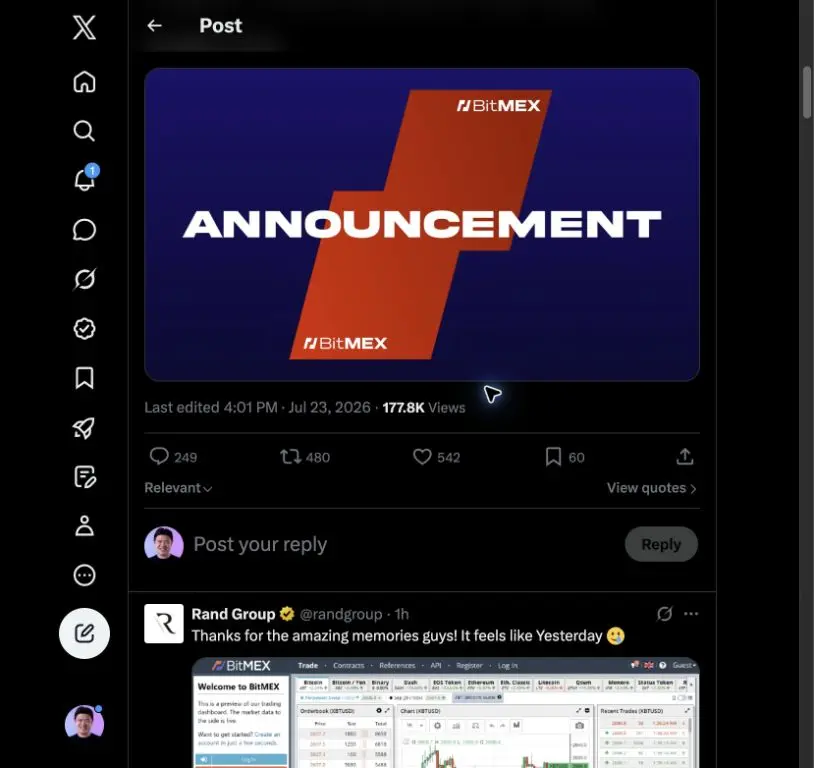
That legacy was front and centre in the immediate response on X. Replies ranged from traders recalling the 2016–18 era and the platform's trollbox culture to rival exchanges acknowledging BitMEX's role in building the industry.
What BitMEX users should do
- Review every open position and close it yourself before the reduction-only period and closure deadline.
- Withdraw assets to a wallet or destination you control, allowing time for network confirmations and any withdrawal review.
- Check that staked BMEX has returned to your account before withdrawing.
- Use only the official BitMEX closure notice and the platform's normal support channels; do not rely on unsolicited messages offering faster withdrawals.
- Keep account and transaction records. BitMEX says historical transaction information will remain visible after closure, but it is sensible to retain your own copies.
BitMEX's full notice is the primary source for the timeline, fees and wind-down procedures. Users with account-specific questions should contact BitMEX Support.
BitMEX closure FAQ
When will the BitMEX Exchange close?
BitMEX says the exchange will close on 23 September 2026 at 04:00 UTC. Its official notice remained unchanged when this article was checked on 13 August 2026.
Can users still open a new BitMEX account?
No. BitMEX stopped accepting new account registrations when it announced the closure on 23 July 2026.
When does BitMEX become reduction-only?
From 26 August 2026 at 04:00 UTC, planned risk limits will prevent users from opening new positions. Customers will only be able to reduce existing positions.
What happens to open BitMEX positions at closure?
BitMEX says it may force-close positions during the wind-down and will immediately force-close any positions still open at the final closure time.
Should users withdraw before BitMEX closes?
Yes. Although BitMEX says balance viewing and withdrawals will remain available afterward, it strongly urges customers to close positions and withdraw assets before the deadline.
Will BitMEX charge for balances left after closure?
According to the closure notice, KYC-verified accounts with remaining assets will face a monthly account fee equal to the greater of US$50 equivalent or 1% per annum of the balance.
What happened to staked BMEX tokens?
BitMEX says it unstaked all staked BMEX when the closure was announced, making the tokens available in holders' accounts for withdrawal.
Why is BitMEX closing?
The company cites a strategic review of its business and the crypto industry. The more detailed competitive and regulatory explanation in this article is Boxmining's evidence-based assessment, not an official cause confirmed by BitMEX.
How can users avoid BitMEX closure scams?
Use the official BitMEX website and normal support channels, verify the domain, and ignore unsolicited messages promising priority or accelerated withdrawals.
Will BitMEX users retain transaction records?
BitMEX says historical transaction information will remain visible after closure, but users should download and retain their own account and transaction records before the shutdown.
This article is news and information, not financial advice. Crypto assets and derivatives are high risk.
Share
Found this useful?
Share it with someone who'd want to read it.
Related

Why Crypto Pumped Today: Inside ETH’s 17% Short Squeeze
The August 19 crypto rally began in the bond market, accelerated through one of the largest short squeezes in years and then rotated violently into Ether. Here is the evidence, the timeline and the risk of a reversal.
Cold Wallets Failed the Boring Way: A 2021 RNG Bug and $130M+ in Stolen Bitcoin
Coldcard routed seed generation to a weak software PRNG for years. Attackers are sweeping wallets offline, and firmware fixes do not save old seeds.

Crypto News September 13, 2025: What Happened Next
A fact-checked archive of the September 13, 2025 crypto news: historical BTC, ETH and SOL prices, Project Crypto's outcome, the USAT launch, GIWA testnet and missed forecasts.