
Binance Futures offers leveraged derivatives, including USDⓈ-margined and coin-margined contracts, where available. Perpetual contracts have no expiry and use funding payments to stay near an underlying index. Delivery contracts expire under their published specifications. Neither product gives the trader ownership of the referenced asset.
The original 2022 guide contains obsolete pair counts, fees, BUSD benefits, leverage limits, insurance-fund values and interface steps. These variables change by contract, position size, VIP tier and jurisdiction. The live contract specification and fee schedule must be checked before every trade.
High-risk warning: Leverage magnifies losses as well as gains. Binance can liquidate a position when its margin falls below maintenance requirements, generally using mark price rather than the last traded price. Stop orders can slip or fail to fill in a fast market, and an insurance fund does not insure a user’s account balance.
Binance Futures status in 2026
| 2022 claim | Current status |
|---|---|
| 279 trading pairs | Obsolete; listings and delistings change continuously |
| Universal 100x or 125x maximum | Obsolete; leverage depends on contract and notional tier and can be changed |
| BUSD-settled contracts and BUSD fee benefits | Historical; Binance wound down BUSD product support |
| Fixed maker/taker fee examples | Historical; current fee tier, contract and promotions determine the rate |
| $300 million insurance fund | Obsolete snapshot; fund balances change and are not user deposit insurance |
| Futures available after five universal steps | Availability, onboarding and suitability requirements differ by jurisdiction |
| Copy trading and Battle Mode | Interface products can be changed or removed and are not core contract mechanics |
Contract types and settlement
USDⓈ-M contracts use a supported stablecoin as margin and settlement collateral. COIN-M contracts use cryptocurrency-denominated collateral and settlement. The latter adds “inverse” exposure: the collateral itself can lose value while a leveraged position moves against the trader.
Perpetuals exchange funding between longs and shorts at contract-specific intervals. Delivery futures instead have an expiry and settlement process. Funding, expiry, tick size, minimum notional, margin asset and leverage tier must be checked for the exact symbol.
Margin, leverage and liquidation
Initial margin opens a position; maintenance margin is the minimum required to keep it open. Higher leverage supplies less initial margin relative to notional exposure, leaving less room for an adverse move. Maximum leverage often falls as position notional increases.
In isolated margin mode, assigned margin is limited to that position unless the trader adds more. Cross margin shares eligible balance across positions, which can delay one liquidation but expose a larger portion of the account. Neither mode prevents losses.
Binance uses mark price for unrealized PnL and liquidation logic to reduce manipulation from isolated last-price trades. A liquidation engine attempts to close the position. If bankruptcy losses exceed available mechanisms, the insurance fund and ultimately auto-deleveraging rules can affect counterparties.
Orders and risk controls
Limit orders control price but may not fill. Market orders prioritize execution but can suffer slippage. Stop-loss and take-profit instructions are conditional orders, not guaranteed prices. Reduce-only instructions can help prevent an exit order from opening an unintended opposite position.
Before trading, define maximum account loss, position size and invalidation price without relying only on the exchange’s liquidation estimate. Keep additional collateral separate if losing the entire futures wallet would be unacceptable. Two-factor authentication and anti-phishing controls reduce account risk but cannot make leveraged trading safe.
Regulatory and platform availability
Binance products are not offered uniformly worldwide. A product visible in a tutorial may be unavailable or restricted based on residence, verification status or local rules. Using a VPN or false residency information to bypass controls can create account, withdrawal and legal problems.
An exchange is a custodian and counterparty. Outages, order-book gaps, account restrictions and insolvency are distinct from market risk. Traders should not keep unrelated long-term holdings in a derivatives margin account.
Original December 2022 Binance Futures guide (historical archive)
The original author-written instructional sections below are preserved substantially intact. Counts, fees, BUSD references, leverage, interface locations and insurance-fund figures reflect 2022. Referral codes, fee-discount promotions and mismatched Bybit banner images were removed.
Crypto futures trading allows traders to have exposure to cryptocurrencies without the need to own the underlying crypto asset. Binance exchange offers futures trading to users through Binance Futures, which has 279 trading pairs. This article provides a guide on how to trade on Binance Futures.
What is Binance?
Binance was launched in 2017 and is arguably the world’s most popular centralized cryptocurrency exchange. It has over 2 billion average daily volume and 72 million site visits daily. The Binance ecosystem includes Binance exchange, BNB Chain, Trust Wallet, Binance card, and other services.
What is crypto futures trading?
Crypto futures contracts create an obligation for parties to exchange the asset at a predetermined price and date. On most cryptocurrency exchanges, however, the parties can settle for the cash equivalent. But, the trade must take place.
Traders use futures trading to profit from market movements by going either “long” or “short” on a futures contract. Going “long” means that a trader purchases a futures contract expecting it would increase in value in the future. And if the value of the cryptocurrency does increase, the long trader would profit. On the other hand, a trader going “short” means they are hoping prices will drop.
Learn more about crypto futures trading with our guide- Crypto Futures Trading: What is it?
What is Binance Futures?
Binance Futures allows users to trade crypto futures contracts on Binance. It has 279 trading pairs and has the second-highest 24-hour trading volume amongst all crypto derivative exchanges. Binance Futures offers USDⓈ-M Futures and COIN-M Futures. These are perpetual or quarterly contracts settled in USDT/BUSD, or cryptocurrency respectively.
Binance Futures also has interesting features such as a leaderboard, showing traders with the highest ROI or PNL. Other traders can follow these top traders and see what positions they are holding, as well as copy their trades.
For traders who are more competitive, Binance Futures has a battle mode where you can guess whether prices will rise or fall within the next 1 or 5 minutes. Then, you will be matched with another player who predicted in the opposite direction. Players will still gain points regardless of whether they win or lose. Points can then be used to earn further rewards.
Binance Futures trading fees
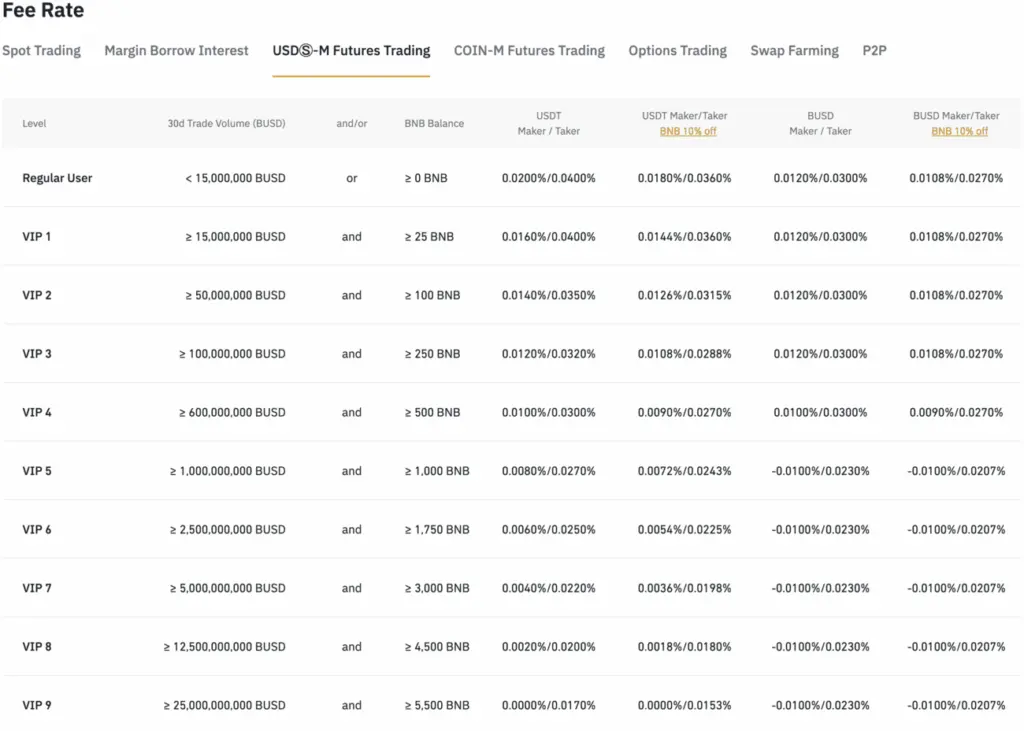
Binance uses a maker-taker fee structure. Maker trades are orders that go on the order book partially or fully e.g. limit orders. Taker trades are executed immediately before entering the order book. Market orders are a type of taker trade. The fee charged depends on which type of trade. As maker trades add volume to the order books and thus “make” the market, it is in an exchange’s interest to have more of these orders. Therefore, maker fees are usually lower than taker fees.
Binance also has a 9-tier VIP structure which offers progressively lower fees for users with high trade volume and substantial BNB holdings. Users who use BUSD, Binance’s USD stablecoin, or BNB for settling fees are also rewarded with lower trading fees.
The lowest tier, i.e. “Regular users” are traders with a past 30-day trading volume of less than 15 million BUSD or hold 0 BNB. For regular users, the maker/taker fee for USDⓈ-M futures trading is 0.02%/0.04%, and for COIN-M futures, the maker/taker fee is 0.01%/0.05%.
Highest tier users i.e. VIP 9, users must have a past 30-day trading volume of over 25 billion BUSD and hold over 5,500 BNB. VIP 9 users enjoy a maker/taker fee of 0.00%/0.017% for USDⓈ-M futures trading, and for COIN-M futures, the maker/taker fee is -0.009%/0.024%.
Pros and advantages of trading on Binance Futures
Binance is one of the leading cryptocurrency exchanges. According to CoinGecko, Binance has the second-highest trading volume with over US$35 million being traded in 24 hours. Here are some of the pros and advantages of crypto trading on Binance Futures:
- Many trading pairs. Binance Futures have 279 trading pairs, giving traders a wide range of options from popular cryptocurrencies such as Bitcoin ($BTC), to meme coins such as Shiba Inu ($SHIB).
- Low trading fees and generous fee structure. Maker/taker fees start at 0.02%/0.04%. However, Binance Coin ($BNB) and BUSD holders, and high-volume traders are entitled to discounts, bringing trading fees to as low as 0.0100%/0.0207%.
- Low minimum trade amount. Traders can start with a minimum trade amount of 0.001 BTC on the BTCUSDT Perpetual market.
- Binance offers up to 100x leverage. This allows more experienced traders to potentially maximise their gains.
- Binance has trading tools such as Grid Trading, TWAP, Advanced TP/SL, and Multi-Symbols Trading Page for maximum trading efficiency.
Cons and disadvantages of trading on Binance Futures
- Futures trading is not available in the US. So US traders will need to use other exchanges for futures trading.
- Users must pass the verification process in order to begin using Binance Futures.
Is Binance Futures trading safe?
Binance has a US$300 million Insurance Fund to protect traders. The Fund acts as a safety net to protect bankrupt traders from adverse losses whilst ensuring that winning traders are paid in full. The purpose of Binance’s insurance fund is to limit counterparty liquidations. Counterparty liquidations are where the positions of opposing traders are automatically liquidated in order to cover a bankrupt trader’s position. The insurance fund takes the remaining positions when a trader in liquidation has less than 0 USDT after all their positions are liquidated. These remaining positions would be offloaded onto the market gradually and liquidation fees will be collected from users that do not result in bankruptcy.
Binance also has a Cooling-Off Period function to help traders prevent compulsive trading behaviours. It works by preventing traders from trading futures-related products on the exchange for a predetermined period.
How to start trading on Binance Futures
Trading on Binance Futures only requires 5 simple steps.
1. Sign up for a Binance Account
On the Binance main page, click register and enter your details.
You can sign up with your phone, email, Google, or Apple accounts.
2. Open a Binance Futures account
Go to Binance Futures and click Open Now. Then, complete the required knowledge assessment if prompted.
3. Complete the verification process
Click Profile and then Verification. Follow the steps and fill in your personal information. A government-issued ID (e.g. a passport) and address proof must be provided, and you must also pass the facial recognition test.
4. Make a deposit into your Binance account
Binance allows you to deposit fiat or cryptocurrencies into your account. To deposit, click on your profile and go to Dashboard. Under Fund your Account, you can choose to Buy crypto using Mastercard, Visa, Google, or Apple Pay. Users can also choose to Deposit crypto from other exchanges or their hardware wallet.
5. Start trading
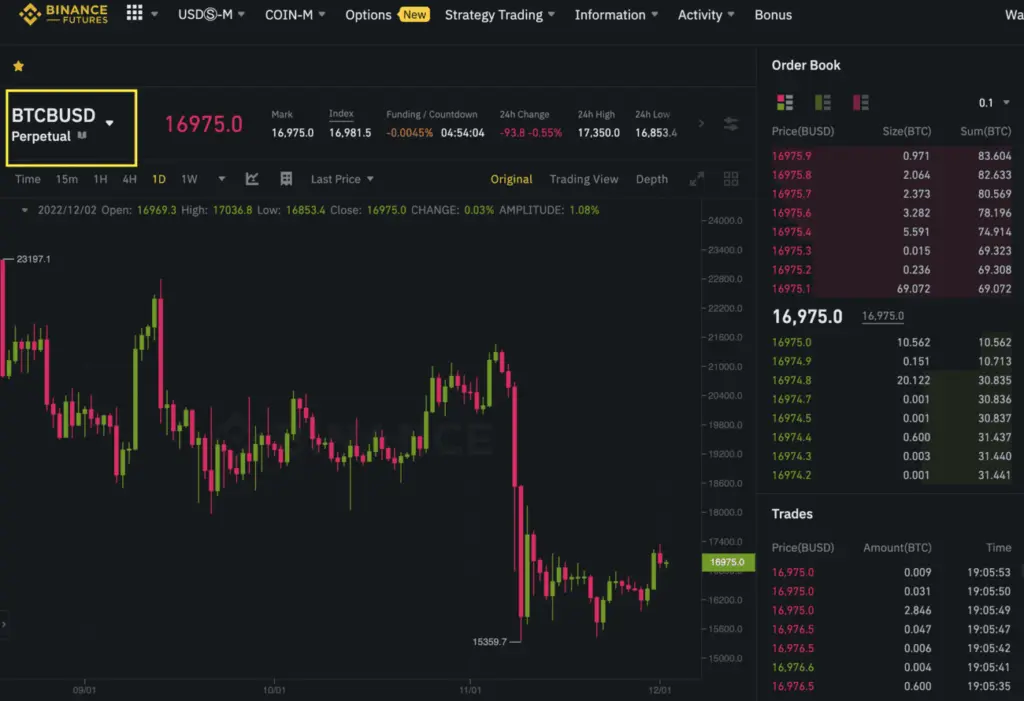
On Binance Futures, choose between USDⓈ-M and COIN-M Futures Contracts. On the top left-hand corner (marked in yellow), you can choose which futures contract to trade.
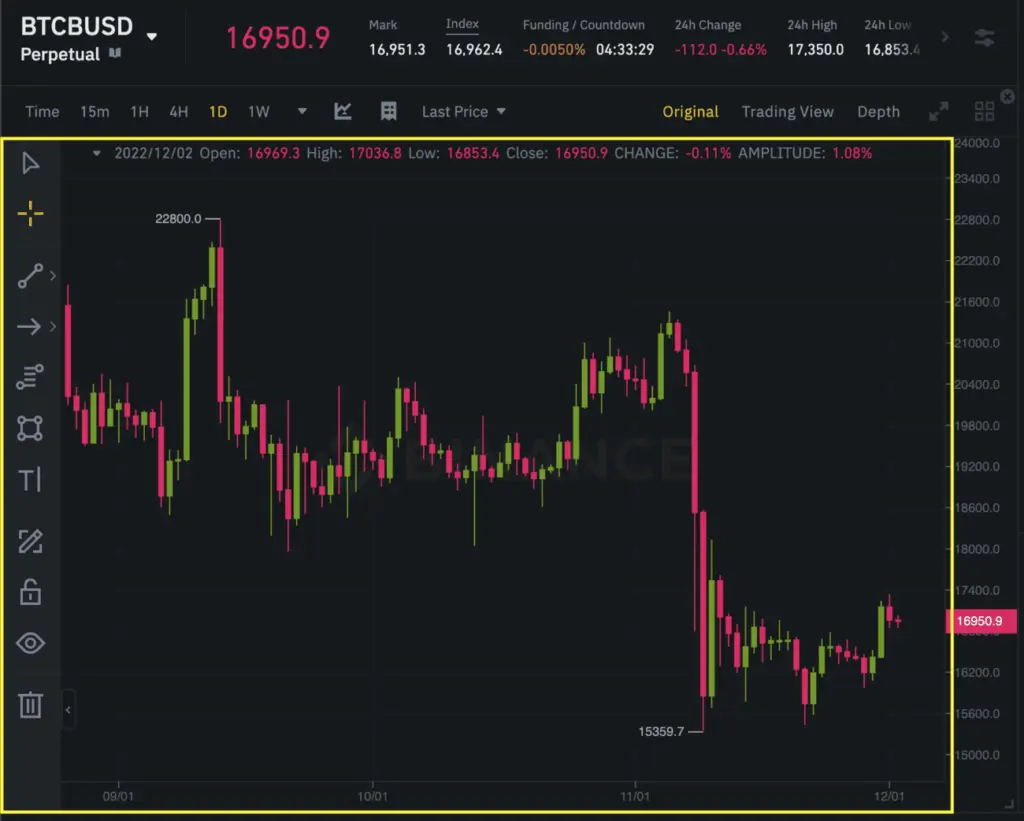
On the left-hand side, there are various tools to help you identify patterns or trades such as trend lines, arrows, or Fibonacci retracement. You can use these tools to annotate your charts.
On the top right-hand side of the page, you can select the Margin Mode. Users can choose between Cross or Isolated margin modes. Cross-margin mode means that the entire margin balance will be shared across open positions. However, if there is a liquidation event, the risk is that their entire margin balance and any open positions may be lost. Isolated margin mode, on the other hand, allows traders to manage their risk on individual positions by restricting the amount of margin allocation. The benefit of isolated margin mode is that if a position is close to being liquidated, users can allocate additional margin to that position.
Set your Leverage (if any) by clicking on the top right-hand corner. Traders can set the leverage from 1x to 125x. However, traders should be careful that setting high leverage could result in significant losses in the event of a liquidation.
On the right-hand side of the page, you can also select the type of order (e.g. Limit, Market, Stop Limit, etc), the order price, and size. For a more automated yet managed trading experience, traders can also select TP/SL i.e. when to take profits, or stop loss. Finally, traders need to select between a Buy/Long, or Sell/Short order.
Is Binance Futures safe?
Binance Futures comes with security features expected from every reputable cryptocurrency exchange. Binance Futures requires users to have passed the KYC verification before they can start trading. Before trades are executed, users must also have enabled 2FA authentication and will be sent an Anti-Phishing Code for verification.
Binance Futures also has a nearly US$300 million insurance fund to protect bankrupt traders from adverse losses. It also ensures that profits of winning traders are fully paid out.
Finally, if users really need help, Binance offers customer support in 17 different languages via Live Chat or email.
Conclusion
Trading futures contracts are a great way for cryptocurrency traders to profit from fluctuations in cryptocurrency prices. Furthermore, Binance Futures is a popular exchange for traders of any level to trade futures since they have a large number of trading pairs. Binance Futures also has the benefit of a huge insurance fund, helpful tutorials, and customer support to ensure that customers have a straightforward and secure trading experience.
Frequently asked questions
What is Binance Futures?
It is Binance's derivatives platform for eligible users, offering products such as USDⓈ-M and COIN-M perpetual or delivery contracts.
Do Binance perpetual futures expire?
No. Perpetual contracts do not expire and use funding payments to help track the underlying index. Delivery futures have published expiries.
What is the difference between USDⓈ-M and COIN-M?
USDⓈ-M uses supported stablecoin margin and settlement. COIN-M uses cryptocurrency-denominated collateral, adding collateral-price exposure.
What price triggers liquidation?
Binance generally uses mark price and maintenance-margin rules rather than only the last traded price. Exact calculations depend on the contract and tier.
What is isolated margin?
It limits assigned margin to one position unless more is added, reducing but not eliminating the amount exposed to that position's liquidation.
What is cross margin?
It shares eligible margin across positions, which can support one losing trade but can also expose more of the futures account.
Does a stop-loss guarantee my exit price?
No. It is a conditional order and can execute with slippage or remain unfilled depending on order type, liquidity and market movement.
Does the Binance insurance fund protect my deposit?
No. It is a market-risk mechanism for bankrupt positions, not deposit insurance and not a guarantee against trading losses or exchange failure.
What is auto-deleveraging?
It is a last-resort mechanism that can reduce profitable opposing positions when bankrupt losses cannot be covered through normal liquidation and insurance processes.
Is Binance Futures available everywhere?
No. Product access depends on jurisdiction, account eligibility and current Binance rules. Availability must be checked without bypassing regional controls.
Sources and further reading
Share
Found this useful?
Share it with someone who'd want to read it.
Related
Binance Funding Rates Explained: Formula, Intervals and Risks
How Binance perpetual funding payments work, including the premium-index formula, dynamic intervals, mark price and the risks of funding-rate arbitrage.
Bybit Funding Rates: Formula, Timing and Fees
Calculate Bybit perpetual funding fees, understand positive and negative rates, check settlement timing, and separate funding from trading fees.
Aster DEX and ASTER Airdrop Status: 2026 Update
Aster DEX's Stage 2 and original ASTER claims are closed. Check the Stage 6 vested-claim dates, current tokenomics, platform changes, and archived 2025 research.