

Introduction
This report provides a historical overview of the crypto project funding landscape as of Q2 2025, with a focus on venture capital investment trends. It was updated in August 2026 with full-year 2025 and Q1 2026 data; the original quarter-specific sections remain intact.
Methodology note: Funding databases do not all measure the same universe. Some include only private-company venture rounds, while others may include token sales, strategic investments, post-IPO debt, acquisitions or public-market transactions. Totals from CryptoRank, Galaxy Research, PitchBook and other providers should not be combined unless their deal definitions match.
2026 update: how 2025 finished
Galaxy Research's later private-market dataset counted $20 billion invested across 1,660 crypto and blockchain deals in 2025, the strongest annual capital total since 2022 and more than double its 2023 figure. Q4 supplied $8.5 billion across 425 deals, with eleven rounds above $100 million accounting for most of the quarter's capital. For the full year, Galaxy found that 57% of invested capital went to later-stage companies.
The next quarter cooled. Galaxy counted roughly $4 billion across 355 private-company deals in Q1 2026, about half Q4's capital, while deal count declined by a mid-teens percentage. Trading, exchange, investing and lending companies received about $2.6 billion. This supports the original article's observation that large, mature businesses were attracting significant capital, but it also shows why a single strong quarter should not be extrapolated mechanically.
Q2 2025 Funding Overview
According to CryptoRank’s Q2 2025 report and its broader fundraising definitions, crypto fundraising experienced a significant surge, reaching levels not seen since the previous cycle. Its quarterly total exceeded $10 billion for the first time in three years. The report associated the increase with improving policy expectations after the change in U.S. administration, although timing alone cannot establish that policy caused every deal.
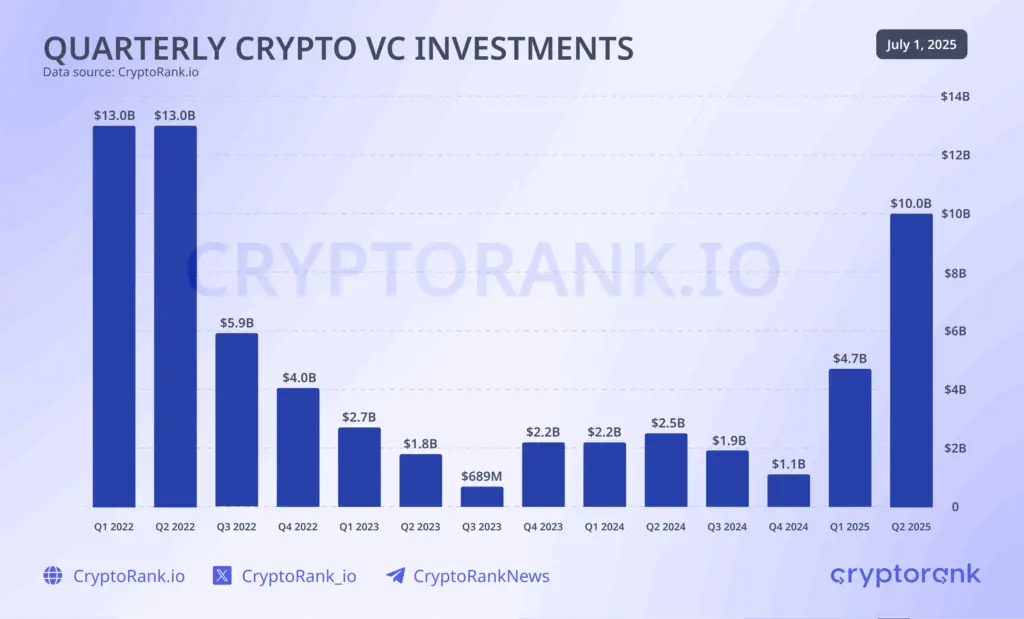
Rising Bitcoin prices alone did not explain venture investment. Galaxy’s full-year review later found that the once-strong relationship between Bitcoin price and startup capital had weakened, although some correlation remained. Regulation, interest rates, fund availability, company maturity, exits and competition from AI all affected allocation decisions.
Late-Stage Deals and Market Maturity
Late-stage deals played a significant role in driving the growth of crypto fundraising in Q2 2025, including IPOs, mergers and acquisitions, and post-IPO debt. These transactions indicate a more mature phase of the crypto market, where high valuations are increasingly supported by revenues and business metrics rather than solely on future potential. The largest share of late-stage funding is observed at the intersection of Web2 and Web3, encompassing centralized exchanges, CeFi protocols, stablecoin issuers, investment funds, and mining companies.
There were 31 deals in Q2 with funding rounds exceeding $50 million, while the smallest number of deals involved check sizes below $1 million. This highlights a rising entry threshold as the market matures and becomes more saturated. More than half of the deals were either undisclosed or classified as strategic, reflecting a shift away from traditional VC models towards a more flexible fundraising approach, driven by the rapid pace of change in the crypto market.
Q1 2025 Funding Trends: Blockchain vs. AI
While Artificial Intelligence (AI) continues to dominate venture funding headlines, blockchain funding has evolved rather than disappeared. In Q1 2025, blockchain and crypto startups collectively raised $4.8 billion, marking the strongest quarter since late 2022. This figure alone represents 60% of the total VC capital invested in 2024.
A notable event in Q1 2025 was MGX’s $2 billion investment in Binance. Binance described it as its first institutional investment and the largest single investment into a crypto company at the time—not the largest venture deal across all industries. One exceptional round also makes the quarterly total less representative of the typical startup.
Key areas of investment within the blockchain sector include:
•Blockchain cybersecurity: Particularly for supply chain security and industrial IoT.
•Tokenization of real-world assets (RWAs): Including real estate and commodities, with predictions of significant CAGR.
•Decentralized finance (DeFi) protocols: These raised $763 million in Q1 2025.
Blockchain is not an alternative to AI but rather a parallel infrastructure supporting trust, ownership, and security. Major trends driving enterprise adoption in 2025 include the integration of AI in blockchain for model auditability and data provenance, the emergence of stablecoins as leading payment rails, and the shift of traditional financial (TradFi) firms towards blockchain technology for process optimization.
Smart VCs are diversifying their capital across both AI and blockchain, recognizing their complementary roles. New use cases are emerging from this convergence, such as AI models with on-chain auditability, smart contracts triggered by AI-driven decisions, and tokenized royalties for AI-generated content.
2025 VC investment projections versus the result
In August 2025, one forecast projected that venture investors could back crypto startups with $25 billion that year. The cited view pointed to Circle’s public listing, Stripe’s acquisition of Privy, increased Wall Street involvement and regulatory developments. Galaxy’s completed-year private-company dataset later recorded $20 billion, showing that the forecast captured the direction but exceeded that provider’s final total.
As of the original August 2025 publication date, the cited source reported $13.2 billion raised and $121 million in one week. Those figures were a point-in-time snapshot under that source’s methodology, not a final annual result. Galaxy’s separately defined dataset ultimately counted $20 billion for 2025.
Investor optimism was also linked to the U.S. administration’s pro-industry stance. The GENIUS Act was not merely “rubberstamped”: it passed the House and Senate and became Public Law 119-27 on 18 July 2025, establishing a federal framework for payment stablecoins. Predictions that it would cause specific funding or acquisition outcomes remained forecasts rather than established facts.
However, potential challenges remain, including macroeconomic uncertainties and the performance of public crypto companies like Circle and Coinbase. Underperformance in these areas could lead to investors tightening their capital flows.
Conclusion
The completed 2025 data confirms a significant resurgence in venture capital investment and an unusually strong later-stage share. A more favorable U.S. policy environment and industry maturity were relevant, but they were not the only drivers. AI competition, interest rates, exits, company fundamentals and a small number of very large rounds shaped the totals.
The $25 billion projection was not reached in Galaxy’s private-company dataset, which counted $20 billion. Q1 2026 then cooled to roughly $4 billion. The defensible conclusion is not that funding will rise continuously, but that capital remained available while becoming concentrated in later-stage businesses and established categories.
Frequently asked questions
How much venture capital went into crypto in 2025?
Galaxy Research counted $20 billion invested across 1,660 crypto and blockchain startup and private-company deals in 2025. Other providers can report different totals because they include or exclude token sales, acquisitions, debt and public-market transactions differently.
Did crypto VC funding reach the projected $25 billion in 2025?
Not in Galaxy Research's private-company dataset, which finished at $20 billion. The older $25 billion figure was a forecast, not a reported result.
What happened to crypto funding in Q1 2026?
Galaxy Research counted approximately $4 billion across 355 deals. Capital fell by about half from the mega-round-heavy Q4 2025, while deal count fell by a mid-teens percentage.
Why do crypto funding reports show different totals?
Providers use different taxonomies, deal dates and inclusion rules. One may count only private equity rounds, while another includes token sales, M&A, post-IPO debt, strategic transactions or undisclosed rounds. Compare trends within one consistent dataset before comparing headline totals.
Did the GENIUS Act become law?
Yes. The U.S. GENIUS Act became Public Law 119-27 on 18 July 2025. It created a federal regulatory framework for payment stablecoins; it did not guarantee more venture funding or business success.
References
•CryptoRank. (2025, July 16). State of Venture Capital in Crypto, Q2 2025. Retrieved from https://cryptorank.io/insights/reports/crypto-fundraising-report-Q2-25
•CV VC. (2025, May 9). Where VCs Are Investing in 2025: Blockchain vs. AI Funding Trends. Retrieved from https://www.cvvc.com/blogs/where-vcs-are-investing-in-2025-blockchain-vs-ai-funding-trends
•DL News. (2025, August 8). Why VC investments into crypto are seen to hit $25bn in 2025. Retrieved from https://finance.yahoo.com/news/why-vc-investments-crypto-seen-113944387.html
•Galaxy Research. (2026, February 3). Crypto and Blockchain Venture Capital – Q4 2025. Retrieved from https://www.galaxy.com/insights/research/crypto-blockchain-venture-capital-q4-2025
•Galaxy Research. (2026). Crypto and Blockchain Venture Capital – Q1 2026. Retrieved from https://www.galaxy.com/insights/research/crypto-blockchain-vc-venture-capital-startups-fundraising-q1-2026
•Congress.gov. S.1582, GENIUS Act, became Public Law 119-27 on 18 July 2025. Retrieved from https://www.congress.gov/bill/119th-congress/senate-bill/1582/all-info
Share
Found this useful?
Share it with someone who'd want to read it.
Related
IX Swap: The Uniswap For Security Tokens & Fractionalized NFTs
Despite the tremendous growth of the decentralized finance (DeFi) industry, it still faces a key problem – the liquidity of operations due…

Public Mint ($MINT): can they bridge fiat and cryptocurrency?
Public Mint seeks to solve transaction complexity by bridging the blockchain and the financial world of fiat.

What Is Canton Network? The Institutional Blockchain Explained
Canton is a public blockchain built for institutions that need atomic settlement and privacy. Here is how it works and what is actually live.